Showing posts with label Quality. Show all posts

Friday, April 18, 2014

An overview of the possible changes in ISO 9001:2015


ISO 9001 or also known as Quality Management System (QMS) was first published its standard in 1987, and later published an updated version in 1994. In an effort to address the constant changing needs of its users, ISO has updated its ISO 9001 standard in 2000 and again in 2008. The current version is known as ISO 9001:2008 whereby the changes were consider to be at a minimum level when compare to the previous version (ISO 9001:2000)

The upcoming ISO 9001 standard in 2015 would involve more changes when compare with the upgrading works needed to be in compliance with 2008 version. For more info, please refer to the links below:

http://www.iso.org/iso/home/news_index/news_archive/news.htm?refid=Ref1633

http://www.mapwright.com.au/New-version-ISO-9001_2015.html

http://www.irca.org/en-gb/resources/iso-90012015/

http://www.lrqa.co.uk/standards-and-schemes/ISO-9001/ISO-9001-Revision.aspx

Friday, December 9, 2011

International Conference On Food Science & Nutrition 2012 In Kota Kinabalu, Malaysia (2-4 April 2012)


International Conference On Food Science & Nutrition 2012 jointly organised by Universiti Malaysia Sabah (UMS), Malaysian Institute of Food Technology (MIFT) & International Union of Food Science and Technology (IUFoST).

More info:
http://www.mift.org.my/files/brochure_1stannouncement.pdf

Friday, August 26, 2011

3rd Business Excellence Global Conference & 17th Asia Pacific Quality Conferance in Singapore


The Singapore Productivity Association (SPA) and SPRING Singapore in collaboration with Asia Pacific Quality Organization (APQO) and Asian Productivity Organization (APO) is organizing the 3rd Business Excellence Global Conference & 17th Asia Pacific Quality Conference, with the theme 'Productivity - Enabling Business Excellence'.

Organisations often wonder how they can become more productive and work within the constraints of limited resources. Leveraging on the business excellence journey will help organisations increase their productivity to maximise their resources and build an internal capability, to effectively grow the business.

The conference will be held from 17th to 20th October 2011 at the Marina Bay Sands and brings together leaders from premier business excellence initiatives, BE award winners from around the globe and subject matter experts in business excellence and quality who will share best practices and insights in managing organisations for success in today's globalized environment. This will provide participants with a unique opportunity to gain a global perspective on best practices in Business Excellence.


CEOs, COOs, senior leaders, directors, dept heads, heads operating units, senior managers, professionals, executives, business /organisational excellence leaders/practitioners, from all businesses, industries and sectors

For more info, kindly log on to:
http://www.begcapqc.com/abt_be.html

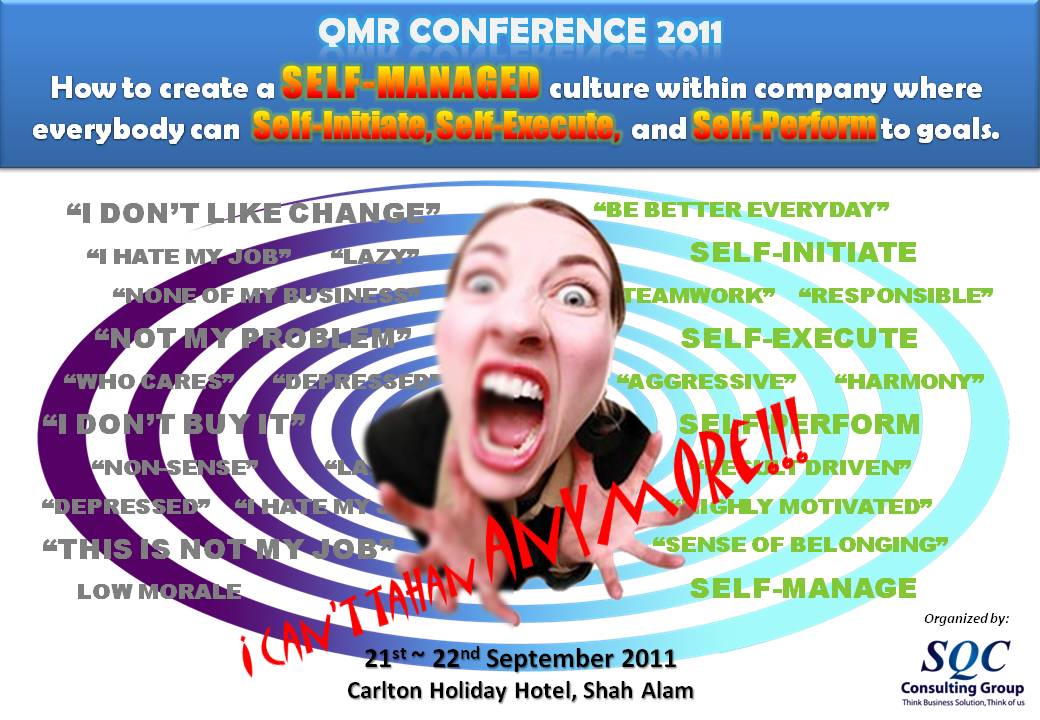
QMR Conference 2011 in Malaysia


For more info, kindly log on to http://www.sqc.com.my/


Sunday, November 7, 2010

The Evolution of Product Quality Approach

The emphasis of quality has evolved through four distinct stages since World War II - from “fix-it-in” to inspect-it-in to built-it-in to design-it-in.

Here are the key differences :
• The fix-it-in approach to quality - Rework any defective products identified by quality inspectors at the end of the production process.
• The inspect-it-in approach to quality - Have quality inspectors sample work in process and prescribe machine adjustment to avoid substandard output.
• The built-it-in approach to quality - Make everyone who touches the product responsible for spotting and correcting defects. Emphasis is on identifying and eliminating causes of quality problem
• The design-it-in approach to quality - Intense customer and employee involvement drives the entire design-production cycle. Emphasis is on continuous improvement of personnel, processes and product.


Progressive managers are moving away from the first two approaches to built-it-in and design-it-in approaches. A popular label for the built it in design and design it in approaches to quality is total quality management (TQM)

Monday, August 30, 2010

Qualcon 2010 International Conference in Quality Management The Third Generation in Quality - Australia (Sept 27-30, 2010)

Qualcon 2010 is organized by Australian Organisation for Quality(AOQ) and the College of Juran Medallists (CJM) and will be held at RYDGES Lakeside Canberra, Australia.

The Third Generation in Quality program will focus on key issues changing the face of management internationally, as Quality is redefined and applied as a 21st century concept. Contribute your thoughts, as you learn from leading international speakers and Australian experts.

The goal of the Qualcon 2010 is to provide delegates with a leading edge evaluation of the implications of Third Generation Quality in the context of your own organisation. The Conference will explore the subject of Third Generation Quality in the context of:
• The theoretical framwework
• Organisational strategy and development.
• Risk and compliance management
• Accreditation and Certification
• Business Excellence
• Application and case study

The Conference Program will assemble speakers of the highest calibre, from Australia and abroad, aiming to equip quality professionals and business leaders on current trends and future directions.

Any organisation planning to market their products and services should consider the opportunities to get involved with sponsorship and exhibiting at this event. The types of organisations that have previously supported the Conference are universities, accreditation bodies, business management consultants, training providers and risk management organisations, amongst others.

The Conference program is especially designed to provide a networking, information transfer and educational opportunity, enabling delegates to enhance their conference experience with fellow delegates.

More info:
http://www.2010.qualcon.com.au/conference.html

16th APQO / NQPCN International Conference on Quality in Nepal (Sept 18-20, 2010)

More info:

FMM (ASQ) Certified Quality Engineer (Oct 30, 2010 - May 21,2011)


FMM (ASQ) Certified Manager of Quality / Organisational Excellence (Oct 23 2010-Feb 26 2011)


Sunday, August 29, 2010

St Nicholas home gets ISO award


Published by The Star on Sunday August 22,2010
GEORGE TOWN: The St Nicholas home for the visually impaired is among the first to receive the ISO 9001:2008 certificate for quality service system from the European Quality Assurance.

The home, located in Jalan Bagan Jermal here, was selected following its provision of training and services for the blind and visually impaired.

Its executive director Daniel Soon said the award would enable more donors to contribute to the home.

“We are proud of the award as it would prove that every sen donated will be used wisely and documented,” he said yesterday.

Soon said it took about three years to prepare for the ISO recognition and they expect to get another ISO accreditation for its administration by end of the year.

Penang Health, Welfare, Caring Society and Environment Committee chairman Phee Boon Poh handed over the certificate to home chairman Rt Rev Andrew Phang See Yin. — Bernama

Saturday, August 28, 2010

Quality certified

Published by The Star on Sunday July 18, 2010
Masterskill Education Group was recently awarded the ISO 9001: 2008 certification by Moody Certification Malaysia.

The certification was awarded to Masterskill University College of Health Sciences (MUCH) in Cheras and its three associate campuses in Perak, Kelantan and Sabah under the scope of “Provision of Nursing and Allied Health Educational and Training Programmes.”

Masterskill’s group chief executive officer Datuk Seri Edmund Santhara said that the company constantly puts emphasis on improving the quality of its courses.

“In tandem with our mission to be the centre of excellence in producing quality professional human capital, we have been steadfast in our objectives which are to achieve a minimum of 85% student passing rate and an 80% total student satisfaction in line with an 80% excellent rating of lecturers,” he said.

Moody International (Malaysia) Sdn Bhd Certification Governing Council chairman Datuk Dr M Mohinder Singh said in his speech, “While the growth in education opportunities have made it easier for everyone to go to a university or college, the question foremost in many minds is whether standards will be maintained.

“This is where the need for quality accreditation comes in.”

At a press conference after the ceremony, Deputy Higher Education Minister Datuk Saifuddin Abdullah said that while it was good to get ISO certifications, the ministry would not make it compulsory for all higher education institutions to do so as they were autonomous bodies.

He also reminded Malaysians to not stereotype students based on the higher education institutions they attend, be it public or private.

“It is not right for people to label students based on the status of their higher education institutions, as they both have their pros and cons.”

He also suggested that the Malaysian Universities Sports Council (Masum) and Sports Council of Private Institutions (Masiswa) merge into one, as that would help to close the gap between the public and private institutions. — By ALYCIA LIM

http://thestar.com.my/news/story.asp?file=/2010/7/18/education/6675268&sec=education

Wednesday, December 23, 2009

Thoughts from the Top (Public Bank)

Prudent management and solid financials make Public Bank Malaysia's Most valuable Brand after two years as No. 2.

Their strategies:
+ Malaysians trust Public Bank because of its solid financial position, prudent management and superior and long track record of financial performance. Public Bank was not involved in subprime mortgage-backed securities and other toxic securities,” says Tan Sri Tay Ah Lek, managing director of Public Bank

+ Its performance has earned Public Bank - Best Retail Bank in Malaysia this year from Asian Banking and Finance and The Asian Banker. The latter also awarded the bank the title of Best Retail Bank in Asia-Pacific 2009, while in FinanceAsia’s Asia’s Best Managed Companies 2009 poll, Public Bank emerged as the best managed company and had the best corporate governance.

+ Public Bank has also earned the trust of the community through its corporate social responsibility (CSR) programmes which are “enshrined in its corporate philosophy”.

+ Public Bank also employs a fair and transparent performance-based remuneration system and meritocracy-based career path.

+ Public Bank group seeks to keep its position as the most efficient, profitable and respected financial institution in Malaysia and the Asia-Pacific and in this, it will be helped by its strong brand.

Full Article:
MMVB 2009: Unwavering trust from customers

Malaysia's 30 Most Valuable Brands 2009 by The Edge

1. Public Bank
2. Maybank
3. CIMB
4. Celcom
5. Parkson
6. Resorts World Genting
7. Digi
8. Astro
9. Sime Darby
10.Petronas

11. Perodua 12. Hong Leong Bank 13. Giant 14. AmBank 15. YTL
16. Malaysia Airlines 17. RHB Bank 18. TV3 19. Air Asia 20. The Star
21. JobStreet.com 22. Dutch Lady 23. Padini 24. Sin Chew 25. Affin Bank
26. Alliance Bank 27. Kurnia 28. Premier 29. Sunway City 30. Bonia

Thoughts on Quality

1. Everything can be improved. C. W. Barron

2. Quality is remembered long after the price is forgotten. Gucci Family Slogan

3. The quality of expectations determines the quality of our action. Andre Godin

4. Quality begins on the inside... and then works its way out. Bob Moawad

5. Quality is not an act, it is a habit. Aristotle

6. Quality is the result of a carefully constructed cultural environment. It has to be the fabric of the organization, not part of the fabric. Philip Crosby

7. Quality questions create a quality life. Successful people ask better questions, and as a result, they get better answers. Anthony Robbins

8. Almost all quality improvement comes via simplification of design, manufacturing... layout, processes, and procedures. Tom Peters

9.The quality of a leader is reflected in the standards they set for themselves. Ray Kroc

10. We never, then, love a person, but only qualities. Blaise Pascal

Sunday, October 25, 2009

7 QC Tools: The What & Who Story


What's that?
  • Fundamental instruments to improve the quality of the product

  • Effective problem-solving tools for quality and productivity improvement

Who's in the list?

  • Ishikawa diagram (Fish bone Diagram/Cause & Effect Diagram)

  • Parento chart

  • Check sheet

  • Control Chart

  • Flow Chart

  • Histogram

  • Scatter Diagram

Saturday, October 24, 2009

GMP: A Brief Intro


  • Good Manufacturing Practices

  • Procedures to ensure products (pharmaceutical/food/medical devices) are manufactured to meet a certain quality and safety requirement

  • These procedures describe the methods, equipment, facilities and controls for all manufactured goods

  • GMP programs ensure HACCP plans focus on CCPs to produce safe food packaging material

  • Prerequisite program for food packaging material quality and safety plans e.g. HACCP, ISO9001, ISO 22000, BRC

Friday, October 23, 2009

ISO : What's that?


International Organization For Standardization


  • Word derived from Greek -ISOS which means "Equal"

  • HQ located in Geneva Switzerland

  • The mission 1:-To promote the development of standardization and related activities in the world with a view to facilitating the international exchange of goods services

  • The mission 2: -To develop cooperation in the spheres of intellectual, scientific, technological and economic activity

Wednesday, October 21, 2009

Principles Of Quality Management System (ISO 9001)


There are 8 principles which form the back bone of the maintenance and sustainability of implementating Quality Management System in an organization.

Principle 1: Customer Focus Organization
  • Organizations depends on their customers. Thus, they should comprehend current and future customer need, meet customer requirement as well as striving to exceed customer expectations

Principle 2: Leadership

  • Establishment unity of purpose and way forward of the organization by the top management. They should create and maintain the internal environment in which people can become fully involved in achieving the organization’s objectives

Principle 3: Involvement of People

  • People at all levels are the essence of an organization and their full involvement enables their abilities to be used for the organization’s benefit.

Principle 4: Process Approach

  • A desire result is achieved more efficiently when related resource and activities are managed as a process.

Principle 5: System Approach

  • Identifying, understanding and managing a system of interrelated processes for a given objective improve the organization’s effectiveness and efficiency.

Principle 6 : Continual Improvement

  • Continual improvement should be a permanent objective of the organization.

Principle 7 :Factual Approach to Decision Making

  • Effective decisions are based on the analysis of data and information.

Principle 8: Mutual Beneficial Supplier Relationship

  • An organization and its supplier are interdependent, and a mutually beneficial relationship enhance the ability of both to create value.


HACCP: A Brief Intro


What is HACCP?
  • Hazard Analysis & Critical Control Point
  • Is a technique / process

  • Is a management system for the assurance of food safety

  • Identifies, evaluates and controls hazards to ensure food safety

  • Can be applied throughout the food chain from primary production to final consumption


How Is HACCP Started?

  • Developed by the Pillsbury Company in USA in 1959 for NASA space program

  • Normal quality test method- destructive test thus not suitable

  • In the 1980’s - HACCP was used for food inspection program

  • By 1992 - system has been improved and its benefits recognized worldwide

Why HACCP?

  • Recomendation by legislations
  • Requirements from customers

  • Insurance against foodborne incidents and diseases


What Is It In For Me?(WIIFM)

  • Cultivate awareness in food safety

  • Increases confidence in food safety

  • Preventive approach reduces reliance on end product testing

  • Internationally recognized

  • Reduces losses and wastage

  • Meets requirements set by the relevant regulatory authority


What Is the 7 Principles Of HACCP?

  • Principle 1: Conduct a hazard analysis

  • Principle 2: Identify critical control points

  • Principle 3: Establish critical limit
  • Principle 4: Establish critical control points monitoring
  • Pricinple 5: Establish corrective action to be taken

  • Principle 6: Establish procedures for verification to confirm that the HACCP system is working effectively

  • Principle 7: Establish document procedures pertaining all procedures and records appropriate to these principles and their application

Calibration Bodies In Malaysia


Sendi Mahir Sdn Bhd
7, Jalan Batu Laut 28/5,
Taman Alam Megah,
40000 Shah Alam,
Selangor Darul Ehsan.
Contact: 03-5191-7388
Fax:03-5191-0675


Pyrometro Services (M) Sdn Bhd
No 19, Jalan U5/11 (PS), Seksyen U5 (Panasuria)
40150 Shah Alam,
Selangor Darul Ehsan
e-mail: hq@pyrometro.com
Contact: +603-5569 1648
Fax: +603-5569 1548


Segatec Sdn Bhd
Wisma Vitar, Lot 590, Jalan Batu Tiga Lama,
Kawasan Perindustrian Sugai Rasa, 41300 Klang

Contact : +603-3342 2022 Fax : +603-3342 2027


Sirim-Sime Technologies Sdn Bhd
Kompleks Sime Darby, Persiaran Kewajipan,
47600 Subang Jaya,
Selangor Darul Ehsan.
Contact: +603-5632 9066
Fax: +603-5632 9077


Metrology Science Centre Sdn Bhd
No. 33, Jalan Kota Raja, L27/L Section 27,
Hicom Town Centre,
40400 Shah Alam
Selangor Darul Ehsan
Contact : +603-5192 6672
Fax : +603-5192 7013


Schutter Far East Sdn Bhd
4203, 3rd Floor, Jalan Susur,
Persiaran Raja Muda Musa,
42000 Perlabuhan Klang
Selangor Darul Ehasn
Contact : +603-31662672
Fax : +603-5569 4201, +603-6157 1836