Showing posts with label Food. Show all posts

Friday, April 18, 2014

How E. coli Interacts With Fresh Vegetables

 
Food poisoning outbreaks linked to disease-causing strains of the bacterium Escherichia coli are normally associated with tainted meat products. However, between 20-30% of these are caused by people eating contaminated vegetables, as was seen in the 2011 outbreak in Europe that caused 53 deaths. Research presented at the Society for General Microbiology’s Annual Meeting in Liverpool shows that the disease-causing E. coli O157:H7 interacts directly with plant cells, allowing it to anchor to the surface of a plant, where it can multiply.
 
Researchers from the James Hutton Institute in Scotland have identified that E. coli O157:H7 uses whip-link structures on its surface known as flagella – typically used for bacterial motility – to penetrate the plant cell walls. The team showed that purified flagella were able to directly interact with lipid molecules found in the membranes of plant cells. E. coli bacteria lacking flagella were unable to bind to the plant cells.
Once attached, the E. coli are able to grow on, and colonise, the surface of the plant. At this point, they can be removed by washing, although the researchers showed that a small number of bacteria are able to invade inside the plant, where they become protected from washing. The group have shown that E. coli O157:H7 is able to colonise the roots of both spinach and lettuce.
Dr Nicola Holden, who led the research, says: “This work shows the fine detail of how the bacteria bind to plants. We think this mechanism is common to many food-borne bacteria and shows that they can exploit common factors found in both plants and animals to help them grow. Our long term aim is to better understand these interactions so we can reduce the risk of food-borne disease.”
 
The researchers believe that the E. coli O157:H7 bacteria use the same method of colonising the surface of plants as they do when colonising the intestines of animals. The work shows that these bacteria are not simply transported through the food chain in an inert manner, but are actively interacting with both plants and animals.
 
While outbreaks of vegetable-associated E. coli outbreaks are rare in the UK as a result of strict control measures at all stages of the food chain from plough to plate, they do still occur, as was seen in 2013 when contaminated watercress entered the food chain resulting in seven people being hospitalised. By understanding the mechanisms of how the bacteria interact with plants, the researchers are hoping to find targeted ways to stop the binding, reducing the risk of food contamination.
 
Source:

Tuesday, April 15, 2014

Dead insect findings prompt Nestlé recall By Joe Whitworth+,


Nestlé said it was 'very concerned' to learn of a consumer complaint about a batch of its cereal in Greece containing dead insects.

More info:

http://www.foodqualitynews.com/Food-Alerts/Dead-insect-findings-prompt-Nestle-recall

Sunday, April 13, 2014

Jack in the Box E. coli Outbreak: Lessons Learned the Hard Way by Bill Marler

 
I have thought a lot over the last 20 years about what lessons can be drawn from the tragedy that was the 1993 Jack in the Box E. coli O157:H7 outbreak. Knowing the children—many who are now nearing 30—who still bear the scars of eating a hamburger, and knowing the parents of those who died, makes it difficult for me to see the benefit of those losses.
 
My first reaction is, “Why does it always seem to take a tragedy before we seem to be able to act?” Whether it was reinforcing the cockpit doors after the horror of 9/11, or now finally having a dialogue about automatic weapons post-Newtown, we have seemed nearly incapable of preventing a tragedy before it has happened multiple times, or with such force that ignoring it any longer is impossible. Frankly, not being able to look ahead to prevent disasters seems so ingrained in human DNA that I am not sure of a ready fix.
 
Human evolution aside, I think there are lessons that can be learned from Jack in the Box that have meaning in the food safety world both in the past and in the future. First, like all food safety failures, and the outbreaks that stem from them, the Jack in the Box outbreak was completely preventable—in other words, Jack in the Box had warnings enough to have prevented the outbreak. And second, after the outbreak there will always be facts—and documents—that prove it.
 
In March of 1992 the Washington State Board of Health mandated that the internal cook temperature for ground beef should be 155 degrees, not the 140 degrees that all other of the 49 states used based on the Federal Food Code. Washington was ahead of the curve because health officials had investigated an earlier outbreak linked to undercooked ground beef. Officials reached out to all restaurants in the State with the new standards. Although Jack in the Box leaders initially claimed that they knew nothing of the changes—and perhaps they did not directly—but the new standards were found in files in corporate headquarters in San Diego.
 
Finding the Washington State Food Code in the bottom drawer of a cabinet was certainly not the best “find” in the litigation. Far from it; a bit of context might be in order.
 
Although the outbreak was announced in mid-January 1993, aggressive litigation and discovery did not really commence until late 1993. It lasted through the end of 1994. During that time, I received nearly 50 boxes of paper from the lawyers representing Jack in the Box and its meat suppliers. From those documents and the dozens of depositions taken, it became clear that Jack in the Box had more than just the new cook temperatures in its desk drawer. Scattered (on purpose) within the boxes were documents that showed that Jack in the Box knew of the new cook-temperature guidelines and simply chose to ignore them.
 
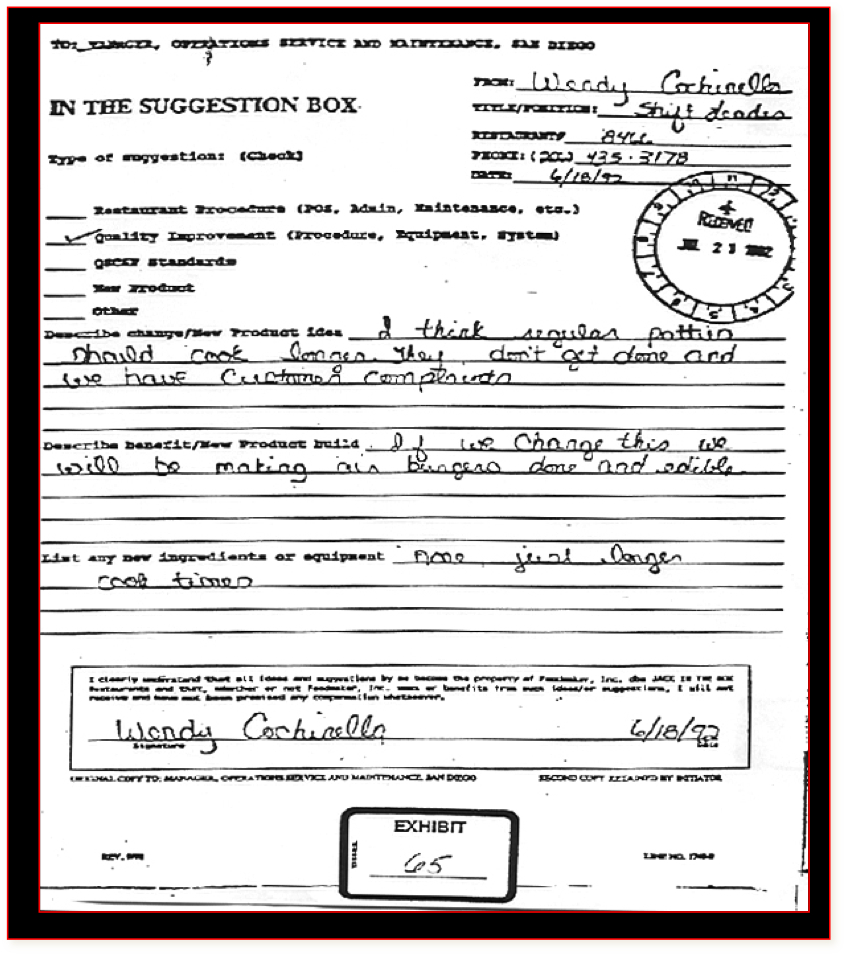
On June 18, 1992—five months before the Jack in the Box E. coli outbreak struck its hometown of San Diego and seven months before it would hit the Pacific Northwest—Wendy Cochinella, the shift leader at the Arlington, Washington restaurant faxed the below “IN THE SUGGESTION BOX” to Jack in the Box corporate headquarters in San Diego:
 
She wrote:
“I think regular patties should cook longer. They don’t get done and we have customer complaints.”
“If we change this we will be making our burgers done and edible.”
 
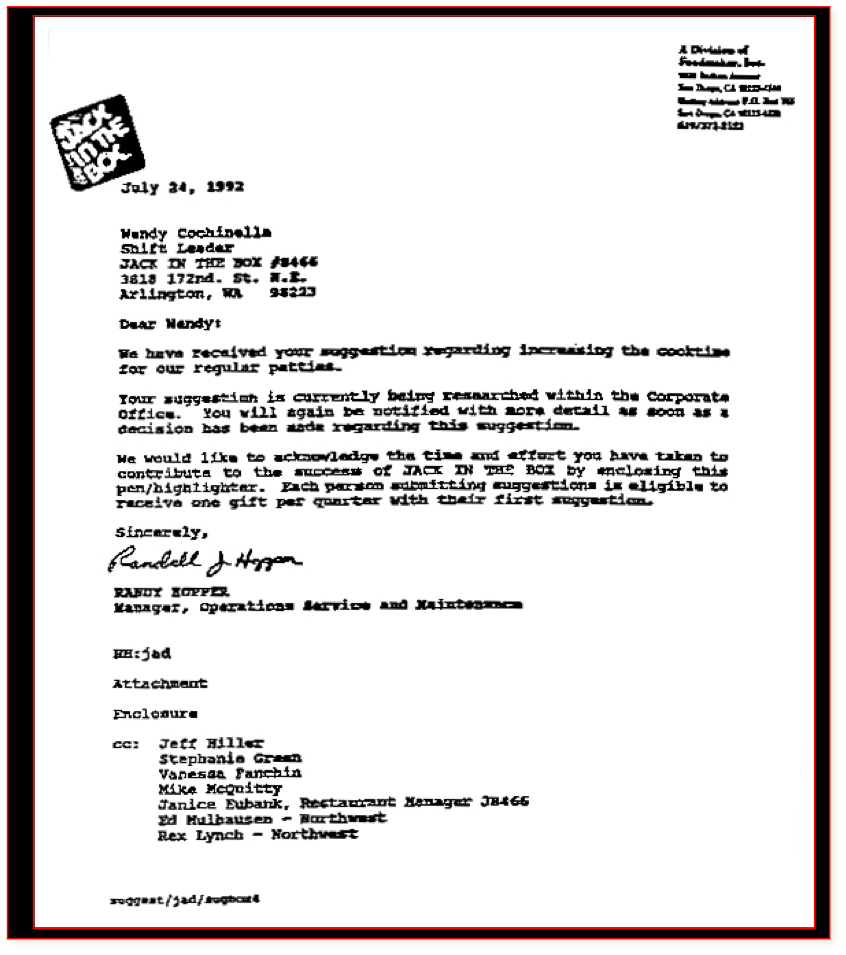
After just over a month, Wendy (and most of the Jack in the Box food safety team) received the below response from corporate headquarters. Wendy also received a pen highlighter (I always thought they should have made her at least Vice-President):
 
It reads:
We have received your suggestion regarding increasing the cook time for our regular patties.
Your suggestion is currently being researched within the corporate offices. You will again be notified with more detail as soon as a decision has been made regarding this suggestion.
We would like to acknowledge the time and effort you have taken to contribute to the success of JACK IN THE BOX by enclosing this pen/highlighter. Each person submitting suggestions is eligible to receive one gift per quarter with their first suggestion.
 
But it did not end there. No, Jack in the Box wanted to see if they could make “[their] burgers done and edible.” What they found in their corporate kitchen was that sometimes they could reach internal temperatures of 155 degrees and above on new grills with the two-minute cook time, but often—too often—internal temperatures of 140 degrees or below were reached on older grills with the two-minute cook time. E. coli O157:H7 bacteria can survive at 140 degrees for two minutes, but not at 155.
So, what was the response?
Yes, you guessed it, the two-minute cook time was more important than having “burgers done and edible.” Wendy’s next communication from corporate headquarters indicated that a cook time longer than two minutes made burgers “tough.”
 
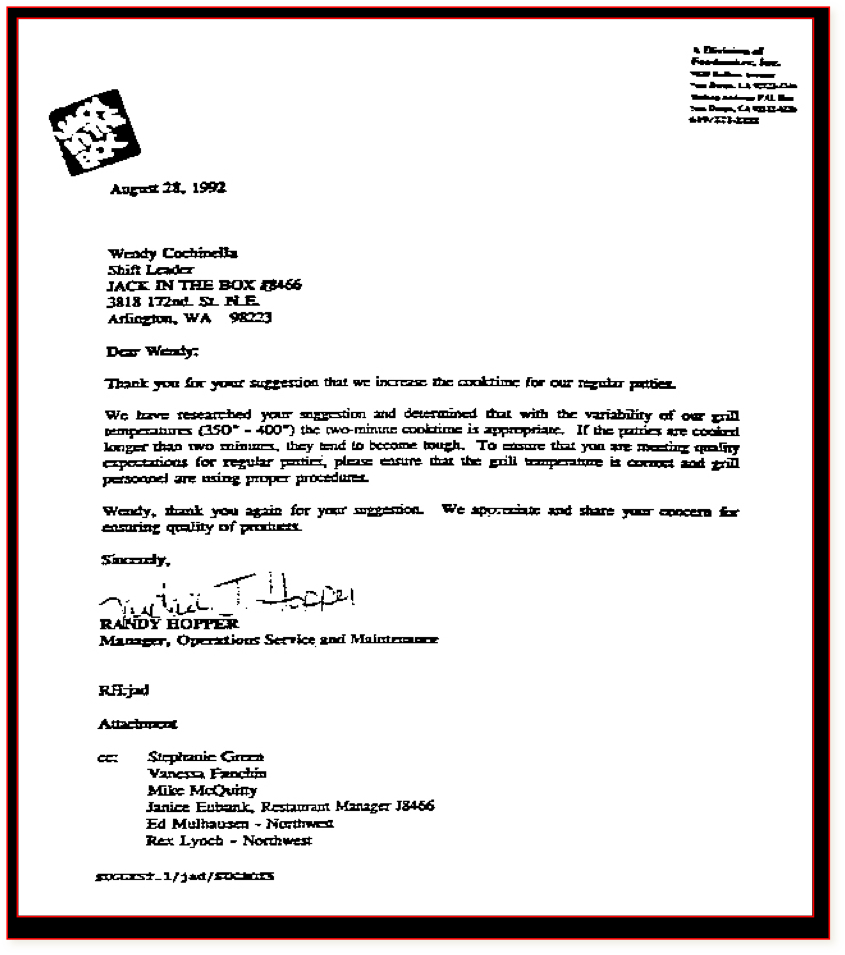
Wendy and the Jack in the Box food safety team received the following communication from superiors:
We have researched your suggestion and determined that with the variability of our grill temperatures (350° – 400°) the two-minute cook time is appropriate. If the patties are cooked longer than two minutes, they tend to become tough. To ensure that you are meeting quality expectations for regular patties, please ensure that the grill temperature is correct and grill personnel are using proper procedures.”
 
And, as they say, the rest is history—a tragic history.  Weeks after the outbreak was announced Jack in the Box changed the cook time from two minutes to two minutes and fifteen seconds – yes, fifteen seconds.

Food Innovation Asia Conference 2014 (12-13 June 2014) in Bangkok, Thailand

Intro:
The conference will provide opportunity to share experiences and strengthen networking among international food scientists and scientists in related fields from academia, government and food industries. The purpose is to highlight significant developments in research and innovations in food science and technology with an emphasis on innovation. There will be presentations and discussions in plenary, concurrent and poster sessions, informal gatherings, competitions and exhibitions.
 
Key highlights:
  • Food Health and Nutrition
  • Food Processing & Engineering
  • Food Microbiology, Food Safety and Quality
  • Food Chemistry and Analysis
  • Food Product Development and Ingredient Innovations
  • Sensory and Consumer Research
  • Food and Agricultural Packaging Technology and Innovations
  • Food Supply Chain Management
  • Food Security and Sustainability
  • Food Related Topics

  • More info? Kindly refer to the link below:
    http://www.fostat.org/index.php/event/food-innovation-asia-conference-2014-main

    IFT 14 Annual Meeting & Expo (21-24 June 2014) in New Orleans, USA

     
    For more info, kindly refer to the link below:
     

    Are secret, dangerous ingredients in your food? by Kimberly Kindy

     
    Food manufacturers are routinely exploiting a “legal loophole” that allows them to use new chemicals in their products, based on their own safety studies, without ever notifying the Food and Drug Administration, according to a new report by an environmental and consumer advocacy group.
    Natural Resources Defense Council identified 56 companies that were marketing products using 275 chemicals that the company’s hired experts decided met federal safety standards, known as Generally Recognized as Safe (GRAS). However, the science behind those safety findings and the use of the chemicals was disclosed to the FDA in only six instances. The New York-based NRDC called its report “Generally Recognized as Secret” and said the lack of transparency with the GRAS process is a public health threat.
     
    “If you don’t know when (an additive) is being used, how can you determine if it’s safe?” said Thomas Neltner, a chemical engineer and co-author of the study that was presented Monday at a Grocery Manufacturers Association’s Science Forum at Washington.
    In a prepared statement, the GMA defended the GRAS process, saying, “It is a very thorough and comprehensive process that has, under the current law provided FDA with authority to challenge the improper marketing of an ingredient as GRAS, and if necessary, act to remove products containing that ingredient from the food supply.”
     
    The FDA said that although the law allows for food manufacturers to make their own safety determinations, the agency “encourages companies to consult with the agency when developing new ingredients.” Ultimately, the FDA said, manufacturers “are responsible for ensuring that their food products are safe and lawful.”
     
    NRDC said that Food Additives Amendment of 1958 was enacted, the GRAS process was meant to apply to innocuous additives like vinegar. Instead, it is commonly used for chemicals that are potentially dangerous and have never before been in the American food supply. For example, until recently, artificial transfats were considered GRAS but the FDA has now deemed them dangerous, saying they cause as many as 7,000 deaths from heart disease each year.The organization said its findings are “likely the tip of the iceberg,” since the scientific work and GRAS determinations are not publicly disclosed and therefore difficult to track down.
     
     
    The organization spent more than a year reviewing trade journals and talking to food additive consultants to identify the 56 companies that frequently make their own safety determinations.
    The FDA’s food additive process allows companies to take several paths to determine the safety of new chemicals or other ingredients.
     
    The most transparent and rigorous path involves companies submitting a food additive petition – along with the science behind why they think the ingredient is safe — to the FDA in an effort to gain formal approval from the agency. Companies use the FDA approvals to promote the safety of their products.
     
    The other, non-public path that NRDC examined allows companies to determine GRAS status on their own without notifying the FDA.
     
    A third path allows companies to voluntarily submit their own GRAS determinations for FDA review and sign off, but they may withdraw the petition if the agency is worried about the safety of the additive. The agency announces the withdrawal but does not disclose whether it had safety concerns. The company may then go ahead and use its own GRAS determination to use the additive in products anyway. The NRDC found that one in every five GRAS petitions were either rejected by the FDA or the company voluntarily withdrew their petition.
     
    NRDC’s report also calls on the FDA to petition Congress for a new law that would require manufacturers to submit their safety determinations to the agency for review and approval. The council said it is encouraging consumers to “demand” that their grocery stores and their favorite brands sell only food products with ingredients that the FDA has found to be safe.
     
    At the event, the Grocery Manufacturers Association also announced a new food additive research center it has helped create at Michigan State University, which will be called the Center for Research on Ingredient Safety (CRIS). GMA’s chief science officer, Leon Bruner, said the center will operate independent of the association and will review the safety of ingredients, train future food toxicologists and serve as an “independent and credible source” for the public, news organizations and the industry.

    Monday, December 26, 2011

    2nd International Conference & Expo on Halal Industry on 16 -17 Jan, 2012 in Lahore, Pakistan

    The key goal of this International Conference is to highlight the importance of consuming Halal food, Halal exports, International halal market potential and to develop an awareness of halal concept among the masses.

    Saturday, December 24, 2011

    Natural & Organic Products Europe 2012 Expo in London on 1-2 April 2012

    Natural & Organic Products Europe is the UK's biggest trade show for both the natural and organic products industries. Over the last 13 years thousands of companies from around the world have set up their UK and European distribution and wholesale networks at the show. If you are looking to enter the UK's massive health food market, this is the leading trade event for you
    More info:

    Tuesday, December 20, 2011

    Bacteria love your homemade chili, too

    The kitchen can be the most popular room during the holidays and eating one of the most beloved traditions. It’s a good time to remember that food-poisoning bacteria also love cooked foods that are high in protein, such as meats, chili, pasta, salad and custard.

    If these foods sit at lukewarm temperatures for more than two to three hours, bacteria can start to grow.

    What happens when you eat spoiled food? “You probably will not feel sick immediately,” said Carolyn Raab, Oregon State University Extension foods and nutrition specialist. “It takes time for the bacteria and their toxins to work in the intestines. Some bacteria can make you sick in just two hours. Others won’t strike for several days.”

    Sometimes, symptoms such as nausea or diarrhea last just 24 hours. Others last for a week or more. Side effects of botulism, the most harmful type of food poisoning, can last for years. Some people may be sicker than others because their immune systems are weak. Pregnant women, infants and young children, older adults and people with cancer, AIDS and other diseases are more at risk.

    It’s important to see a doctor if symptoms are severe or last a long time.


    A common concern about food-borne illness is when you don’t know what food eaten during the previous 24 hours could have been a source of bacteria. “Rare or undercooked foods from animals — meats, poultry, eggs, seafood — can be a source of harmful bacteria. So is raw, unpasteurized milk. Adequate heating kills most bacteria and their toxins,” Raab said.

    Another common cause of food-borne illness is cross-contamination, which spreads bacteria from raw meat, seafood and poultry to other foods that aren’t cooked before eating. This can happen when lettuce is put on a cutting board that was not cleaned after raw chicken is cut up.

    Here are basic rules to keep food safe:

    Keep it clean: Wash your hands with soap and water before handling food, especially after using the toilet or changing diapers. Wash counters, cutting boards and utensils with soap and water after handling raw meat, poultry, seafood and eggs. After washing, wipe or spray with diluted bleach (one teaspoon in one quart of water). Don’t sneeze on food. Put bandages on hand cuts. Keep insects, rodents and pets away.

    Cook it well: Cook meat, poultry, fish and eggs thoroughly. This is how they should look: Ground meat is brownish (cook to 160 degrees). Poultry meat is light or dark brown and its juice is clear (cook to 165 degrees). White fish looks milky and flakes easily with a fork. Egg whites are white and firm. Drink pasteurized milk and fruit juice that has been heat-treated to kill harmful bacteria.

    Cool it soon: Keep hot foods HOT and cold foods COLD. Cool big pots of soups and stews by pouring them into shallow pans (two to three inches high). Refrigerate soon

    Seafood revealed as biggest source of dangerous toxins


    Seafood is the largest source of potentially harmful dioxin-based toxins in the diet of Hongkongers, according to a major food study conducted by the Centre for Food Safety.

    The highest levels were found in mandarin fish, followed by oysters and pomfret.

    However, the toxins are not consumed at dangerous levels based on Hongkongers’ normal eating habits, so the findings were no cause for alarm, said Dr Xiao Ying, a food safety officer at the centre.

    “People should not stop eating fish, because fish contains many essential nutrients,” Xiao said yesterday. Dr Ho Yuk-yin, a consultant in community medicine at the centre, recommended consuming fish three times a week.

    In the first major study of city residents’ diets, researchers tested 142 food samples over the past year, focusing on two powerful classes of toxins – dioxin and dioxin-like PCBs (polychlorinated biphenyls). The samples were drawn from 71 types of food purchased from markets and prepared as they would be served on the table.

    The results were compared to a survey that interviewed more than 5,000 people on their dietary habits.

    To lessen the intake of dioxins, the centre advised Hongkongers to trim the fat from meat and opt for low-fat dairy products, since dioxins are fat-soluble and accumulate in the fatty tissues of meat and seafood. It recommended a balanced diet with a rich variety of fruit and vegetables.


    The study found that the average Hongkonger’s monthly diet contained just 31 per cent of the maximum safe amount allowed for the two toxins. The top 5 per cent of residents consumed 85 per cent of the tolerable limit.

    The safety standard for both toxins is 70 picograms of toxicity equivalents (pg TEQ) per kilogram of body weight per month, set in 2001 by the Food and Agriculture Organisation and the World Health Organisation.

    The test results showed that mandarin fish, oysters and pomfret contained 1.056, 0.926 and 0.885 pg TEQ per gram respectively.

    Dioxins occurred naturally and were by-products of combustion and industrial processes, Ho said. Animals that ingest contaminated plants will accumulate dioxins in their bodies. Some dioxins are carcinogens; long-term exposure may also affect the immune, nervous and reproductive systems.

    The report by the centre’s First Hong Kong Total Diet Study (TDS) is the first in a series that will examine more than 130 contaminants and nutrients in Hongkongers’ food, issuing reports in phases until 2014.

    The TDS approach is widely considered the most cost-effective way to estimate dietary exposure to a range of chemicals and nutrients. Unlike food surveillance programmes, it considers the impact of cooking rather than concentrations of substances in raw food

    Board records statement in cheap cooking oil issue

    Officers from the Malaysian Palm Oil Board (MPOB) recorded a statement from Malaysian Association of Standards Users chief executive officer Ratna Devi Nadarajan in connection with tests which revealed that cheap cooking oil unfit for human consumption was being sold to the public.


    MPOB officers went to the association’s office here yesterday and made copies of proof that samples had been sent for laboratory tests.

    “They took down the list of companies involved and also proof of purchase of the samples,” she said, adding that MPOB also obtained the certificate of analysis of tests carried out by Universiti Kebangsaan Malaysia (UKM).

    The Star reported that 19 brands of cooking oil sold nationwide in 1kg packets were found to be unfit for consumption due to repeated exposure to high temperatures.

    The association, which pursued the study of the commodity with UKM, believed that the re-packaged oil was meant to be recycled into biodiesel for use in diesel engines.

    Ratna Devi stood firm in the association’s decision to send samples of cooking oil for the “polar compound testing”, saying it was a matter of food safety.

    She said the association had no intention to attack the palm oil industry, adding that it wanted to see improvements to the regulations pertaining to the standards of cooking oil.

    “We only hope the test would bring the serious matter to the attention of the authorities,” she said.

    MPOB chairman Datuk Seri Shahrir Samad confirmed that the list of the 19 brands involved had been obtained from the association.

    He gave assurance that MPOB was collecting the samples for its own tests.

    “It’s not wrong for them to conduct their own tests. We are taking the situation se-riously,” he said

    Source: Food Safety Net

    EU: New rules soon on fruit juices


    Following on from the Committee of Permanent Representatives' meeting in mid-November, the European Parliament has now endorsed the new rules that will improve the quality and labelling of fruit juices and ban the addition of sugar to these beverages. Meeting in plenary, on 14 December, MEPs supported by a very large majority the compromise on the proposal for amendment of Directive 2001/112/CE of the Council on fruit juices and certain similar products intended for human consumption.

    The new rules make mainly technical changes based on progress in production methods and provisions of the Codex Alimentarius. They confirm the distinction between fresh juices and concentrated juices or nectars. The rules ban the addition of sugar or sweeteners to fruit juices and permit the industry to indicate this to consumers during a limited period. The directive also improves the clarity of juice labelling so that fruits will be listed in descending order of the volume of juices in the final product (the words 'several fruits' may be used for three or more fruits). All these rules will apply to products manufactured in Europe as well as those imported from outside the Union.

    Once the new directive has been published in the EU Official Journal, the member states will have 18 months to transpose and apply it. Products labelled or placed on the market during this period may still be marketed for an additional 18 months. The Commission may amend the annexes to the directive through delegated acts during a period of five years.

    Source: europolitics.info

    Friday, December 9, 2011

    International Conference On Food Science & Nutrition 2012 In Kota Kinabalu, Malaysia (2-4 April 2012)


    International Conference On Food Science & Nutrition 2012 jointly organised by Universiti Malaysia Sabah (UMS), Malaysian Institute of Food Technology (MIFT) & International Union of Food Science and Technology (IUFoST).

    More info:
    http://www.mift.org.my/files/brochure_1stannouncement.pdf

    Monday, August 30, 2010

    International Conference on Food Research (ICFR 2010) in Putrajaya, Malaysia (Nov 22-24, 2010)


    Hosted by Universiti Putra Malaysia, Malaysian Institute of Food Technology and ILSI, this conference will be a global gathering of more than 500 participants comprising food scientists, technologists, researchers, academicians, industrialists, processors, policy makers and planners from government, industry, academia and international organisations to exchange ideas and provide a chance to socialize, establish networks with colleagues from different parts of the world and create an environment through which they can exchange their knowledge and experiences. It will also be a very good opportunity for young scientists and food science and technology professionals to meet with pioneers in their fields. The theme of the Conference is “Sustainable and Quality Food for All”. National and international speakers will present information on a variety of latest issues and development in a range of subjects relating to food science, technology, service and industry which will enhance food research.

    More info:

    http://www.icf2010.upm.edu.my/index.html

    International Dairy Show 2010 in Texas, USA (13-15 Sept 2010)


    More info:

    How Does Salmonella Get Inside Eggs?


    Article by Remy Melina, Life's Little Mysteries Staff Writer
    LiveScience.com remy Melina, Life's Little Mysteries Staff Writer
    livescience.com – Wed Aug 18, 3:45 pm ET

    Although the average egg looks innocent enough, it can harbor dangerous foodborne bacteria called Salmonella. It's these bacteria that led to the ongoing nationwide recall of Wright Country Eggs. But how do the bacteria get in there?

    The bacteria, Salmonella enteritidis (also referred to as S. enteritidis), can invade an egg in several ways. One way is by the contamination of egg shells with fecal matter. The bacteria are present in the intestines and feces of infected humans and animals, including chickens, and can be passed to the eggs when chickens sit on them.

    Stringent cleaning and inspecting procedures of shells were implemented in the 1970s to decrease this form of contamination, according to the U.S. Department of Agriculture's Food Safety and Inspection Service (FSIS).

    However, outbreaks of salmonellosis (an infection caused by Salmonella bacteria) still happen because Salmonella also silently infects the ovaries of healthy-looking hens, contaminating the eggs inside the chicken before the shells are even formed, according to FSIS. To curb this form of contamination, the egg industry regularly tests hens for the ovarian bacteria.

    Only a small number of hens in the United States seem to be infected with Salmonella at any given time, according to the Centers for Disease Control and Prevention. The CDC also assures that an infected hen can lay many normal eggs while only occasionally laying an egg that's contaminated.

    So how can consumers tell if an egg contains salmonella? There is no way for grocery shoppers to tell if an egg has been contaminated, according to Rob Gravani, a professor of food science at the Cornell University. In fact, Salmonella affect chicken of every quality, and there is no valid scientific evidence that shows that poultry products labeled "Kosher," "free-range," "organic," or "natural" have more or less of the bacteria, according to FSIS.

    "The best thing for consumers to do is to pay attention to the brand of eggs that are being recalled, and to return any eggs that they've purchased of that brand to the store," Gravani told Life's Little Mysteries.

    Health officials also recommend not serving undercooked eggs, since thorough cooking kills the bacteria, according to the CDC. Because both the outside and inside of contaminated eggs appear to be normal, even if an egg seems "safe" to eat with a runny-style yoke, it is always best to err on the side of caution and eat only well-cooked eggs. The FSIS recommends that egg dishes be heated up to an internal temperature of at least 160 degrees Fahrenheit (71 degrees Celsius).

    Typically, a person with salmonella poisoning develops a fever, abdominal cramps and diarrhea approximately 12 to 72 hours after consuming the contaminated food. The illness usually lasts from four to seven days, and most people do not need antibiotics in order to recover.

    However, the elderly, infants, and those with impaired immune systems may be the most susceptible to becoming seriously ill as a result of salmonellosis. In these patients, the infection may spread from the intestines to the blood stream, and then to other parts of the body. This can lead to death unless the person is promptly treated with antibiotics, according to the CDC.


    http://news.yahoo.com/s/livescience/20100818/sc_livescience/howdoessalmonellagetinsideeggs

    Saturday, August 28, 2010

    Health Ministry to conduct checks on bird’s nest

    Published by The Star on Tuesday August 24, 2010
    PETALING JAYA: The Health Ministry’s Food and Safety Department will collect samples of bird’s nest on sale in the market to check for contamination with dangerous chemicals.

    Minister Datuk Seri Liow Tiong Lai said this came in the wake of reports of traders adding chemicals to bird’s nest to turn them into red “blood’s nest” to mark up the price.

    He warned traders that those found guilty of using non-permitted colouring could be jailed up to five years or fined up to RM100,000 or both under the Food Act.

    Liow said the image of the billion ringgit a year bird’s nest industry must not be tarnished especially when most of the production were for export.

    He said the ministry had yet to receive any complaints on tainted bird’s nest.

    The Star reported yesterday that “blood nest” — a much sought after variety of bird’s nest — was actually tainted with chemicals.

    While the normal bird’s nest, which is ivory in colour, can fetch up to RM10,000 a kilo, the reddish “blood nest” fetches up to RM20,000 a kilo.

    In exposing the scam, Deputy Agriculture and Agro-based Industries Minister Chua Tee Yong said this tainted bird’s nests was dangerous to health.

    He said the nests were either sprayed with iodine or stored at premises where there was high ammonia content to give them a uniform bright-red colour


    http://thestar.com.my/news/story.asp?file=/2010/8/24/nation/6906422&sec=nation

    Consumers fall for Nest-y scam

    Published by The Star on Monday August 23, 2010
    PETALING JAYA: “Blood nest” – a much sought after variety of bird’s nest – is actually tainted with dangerous chemicals to deceive consumers into paying double the price for a premium grade.

    While the normal bird’s nest, which is ivory in colour, can fetch up to RM10,000 a kilo, the reddish “blood nest” fetches up to RM20,000 a kilo.

    Traders justify the exorbitant price by claiming the “blood nest” is a premium grade of the Chinese delicacy.

    In exposing this scam on Saturday, Deputy Agriculture and Agro-based Industries Minister Chua Tee Yong said these tainted bird’s nests were dangerous to health and may even be fatal when consumed by humans.

    He said the nests were either sprayed with iodine or stored at premises where there was high ammonia content to give them a uniform bright-red colour.

    “Some also use karya gum (from a soft wooded tree) to give the bird’s nest its reddish colour,” he told The Star.

    Chua advised the public against purchasing bird’s nest from dubious traders and urged the industry to practise self-regulation to ensure the quality and safety of the product.

    He said that all bird’s nests must have a Veterinary Service Department health certificate before they could be exported.

    Federation of Bird’s Nest Merchants Asso­ciations chairman Datuk Beh Heng Seong said the term “blood nest” was coined by conmen and that there was “no such thing”.

    “Bird’s nest is made up of the saliva of swiflets and is ivory in colour. It is impossible for bird’s nest to be red in colour.

    “The so-called blood nests have high levels of nitrates from the artificial red colouring added to it,” Beh said, admitting that many consumers had been deceived into paying a high price for the dangerous product.

    He said a kilo of bird’s nest costs between RM8,000 and RM10,000 in the market depending on the grade while a kilo of the “blood nest” was between RM15,000 and RM20,000.

    Beh said Malaysia produced some 240 tonnes of bird’s nest worth RM1bil a year and 90% of it was exported to China.

    Asked whether the federation, comprising 19 associations and 10,000 members nationwide, had tried to rein in those who were cheating consumers, he said they were looking at educating consumers on bird’s nests and coming up with guidelines for the industry.

    Meanwhile, Fomca secretary-general Muhd Sha’ani Abdullah urged the Health Ministry to issue guidelines on what a genuine bird’s nest was and to warn consumers of bird’s nests with added colouring.

    He said so far, they have not received any complaint from consumers on the so-called “blood nest” but added that could be because consumers were unaware of tainted products in the market.

    He suggested that the Health Ministry issue certificates for untainted products.

    “Traders should also be responsible by making sure no harmful chemicals are used in their products,” said Muhd Sha’ani.

    http://thestar.com.my/news/story.asp?file=/2010/8/23/nation/6902766&sec=nation

    Sunday, December 27, 2009

    Our promise

    Quick recap of what these restaurants are committed to:-

    Mc Donalds (www.mcdonalds.com.my)
    BRAND MISSION To be our customers' favourite place and way to eat.
    BRAND PROMISE To provide Simple Easy Enjoyment to every customer at every visit.


    Secret Receipe (www.secretrecipe.com.my)
    Secret Recipe’s principle is set: to give the best satisfaction to all its valued customers.


    Old Town White Coffee (www.oldtown.com.my)
    Our Goal: To let everyone enjoy every sip of authentic Malaysian Ipoh White Coffee anytime, anywhere.


    Domino's Pizza (www.dominos.com.my)
    Our Vision :Making families, friends and colleagues happy by delivering unforgettable dining experiences.
    Our Mission Statement :Domino's is the pizza specialist who consistently delights the customer with great taste and choices in pizza and with friendly, courteous people providing prompt delivery service.