Showing posts with label Food Safety. Show all posts

Friday, April 18, 2014

How E. coli Interacts With Fresh Vegetables

 
Food poisoning outbreaks linked to disease-causing strains of the bacterium Escherichia coli are normally associated with tainted meat products. However, between 20-30% of these are caused by people eating contaminated vegetables, as was seen in the 2011 outbreak in Europe that caused 53 deaths. Research presented at the Society for General Microbiology’s Annual Meeting in Liverpool shows that the disease-causing E. coli O157:H7 interacts directly with plant cells, allowing it to anchor to the surface of a plant, where it can multiply.
 
Researchers from the James Hutton Institute in Scotland have identified that E. coli O157:H7 uses whip-link structures on its surface known as flagella – typically used for bacterial motility – to penetrate the plant cell walls. The team showed that purified flagella were able to directly interact with lipid molecules found in the membranes of plant cells. E. coli bacteria lacking flagella were unable to bind to the plant cells.
Once attached, the E. coli are able to grow on, and colonise, the surface of the plant. At this point, they can be removed by washing, although the researchers showed that a small number of bacteria are able to invade inside the plant, where they become protected from washing. The group have shown that E. coli O157:H7 is able to colonise the roots of both spinach and lettuce.
Dr Nicola Holden, who led the research, says: “This work shows the fine detail of how the bacteria bind to plants. We think this mechanism is common to many food-borne bacteria and shows that they can exploit common factors found in both plants and animals to help them grow. Our long term aim is to better understand these interactions so we can reduce the risk of food-borne disease.”
 
The researchers believe that the E. coli O157:H7 bacteria use the same method of colonising the surface of plants as they do when colonising the intestines of animals. The work shows that these bacteria are not simply transported through the food chain in an inert manner, but are actively interacting with both plants and animals.
 
While outbreaks of vegetable-associated E. coli outbreaks are rare in the UK as a result of strict control measures at all stages of the food chain from plough to plate, they do still occur, as was seen in 2013 when contaminated watercress entered the food chain resulting in seven people being hospitalised. By understanding the mechanisms of how the bacteria interact with plants, the researchers are hoping to find targeted ways to stop the binding, reducing the risk of food contamination.
 
Source:

Sunday, April 13, 2014

Jack in the Box E. coli Outbreak: Lessons Learned the Hard Way by Bill Marler

 
I have thought a lot over the last 20 years about what lessons can be drawn from the tragedy that was the 1993 Jack in the Box E. coli O157:H7 outbreak. Knowing the children—many who are now nearing 30—who still bear the scars of eating a hamburger, and knowing the parents of those who died, makes it difficult for me to see the benefit of those losses.
 
My first reaction is, “Why does it always seem to take a tragedy before we seem to be able to act?” Whether it was reinforcing the cockpit doors after the horror of 9/11, or now finally having a dialogue about automatic weapons post-Newtown, we have seemed nearly incapable of preventing a tragedy before it has happened multiple times, or with such force that ignoring it any longer is impossible. Frankly, not being able to look ahead to prevent disasters seems so ingrained in human DNA that I am not sure of a ready fix.
 
Human evolution aside, I think there are lessons that can be learned from Jack in the Box that have meaning in the food safety world both in the past and in the future. First, like all food safety failures, and the outbreaks that stem from them, the Jack in the Box outbreak was completely preventable—in other words, Jack in the Box had warnings enough to have prevented the outbreak. And second, after the outbreak there will always be facts—and documents—that prove it.
 
In March of 1992 the Washington State Board of Health mandated that the internal cook temperature for ground beef should be 155 degrees, not the 140 degrees that all other of the 49 states used based on the Federal Food Code. Washington was ahead of the curve because health officials had investigated an earlier outbreak linked to undercooked ground beef. Officials reached out to all restaurants in the State with the new standards. Although Jack in the Box leaders initially claimed that they knew nothing of the changes—and perhaps they did not directly—but the new standards were found in files in corporate headquarters in San Diego.
 
Finding the Washington State Food Code in the bottom drawer of a cabinet was certainly not the best “find” in the litigation. Far from it; a bit of context might be in order.
 
Although the outbreak was announced in mid-January 1993, aggressive litigation and discovery did not really commence until late 1993. It lasted through the end of 1994. During that time, I received nearly 50 boxes of paper from the lawyers representing Jack in the Box and its meat suppliers. From those documents and the dozens of depositions taken, it became clear that Jack in the Box had more than just the new cook temperatures in its desk drawer. Scattered (on purpose) within the boxes were documents that showed that Jack in the Box knew of the new cook-temperature guidelines and simply chose to ignore them.
 
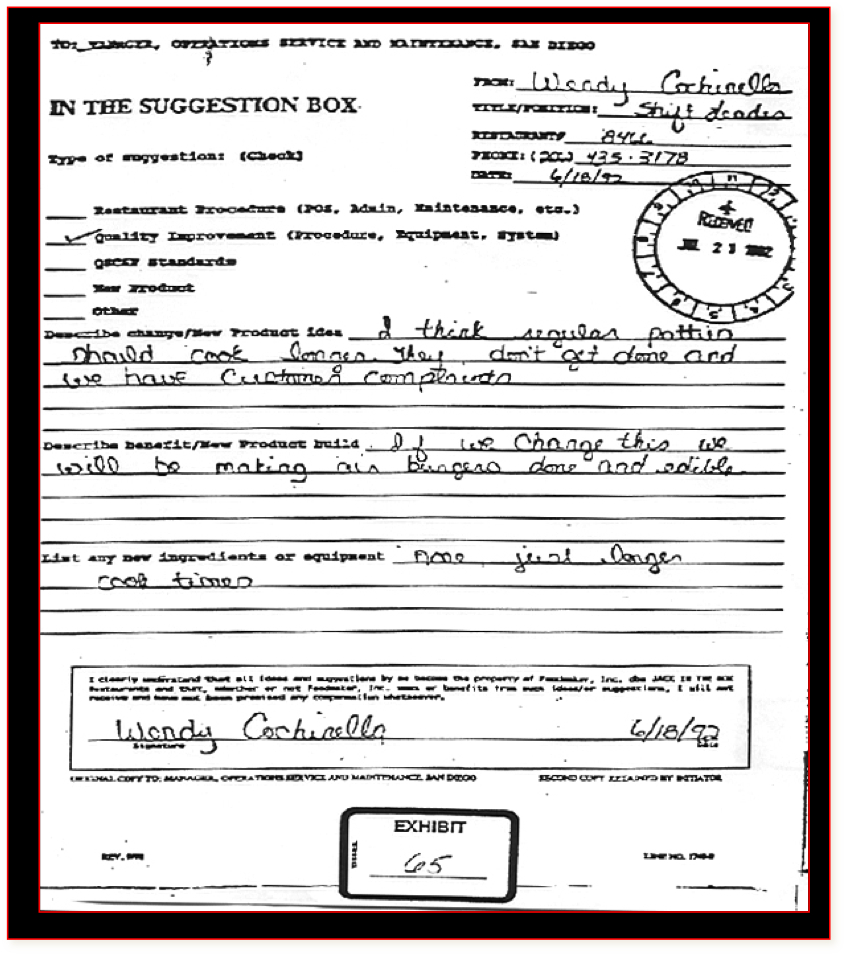
On June 18, 1992—five months before the Jack in the Box E. coli outbreak struck its hometown of San Diego and seven months before it would hit the Pacific Northwest—Wendy Cochinella, the shift leader at the Arlington, Washington restaurant faxed the below “IN THE SUGGESTION BOX” to Jack in the Box corporate headquarters in San Diego:
 
She wrote:
“I think regular patties should cook longer. They don’t get done and we have customer complaints.”
“If we change this we will be making our burgers done and edible.”
 
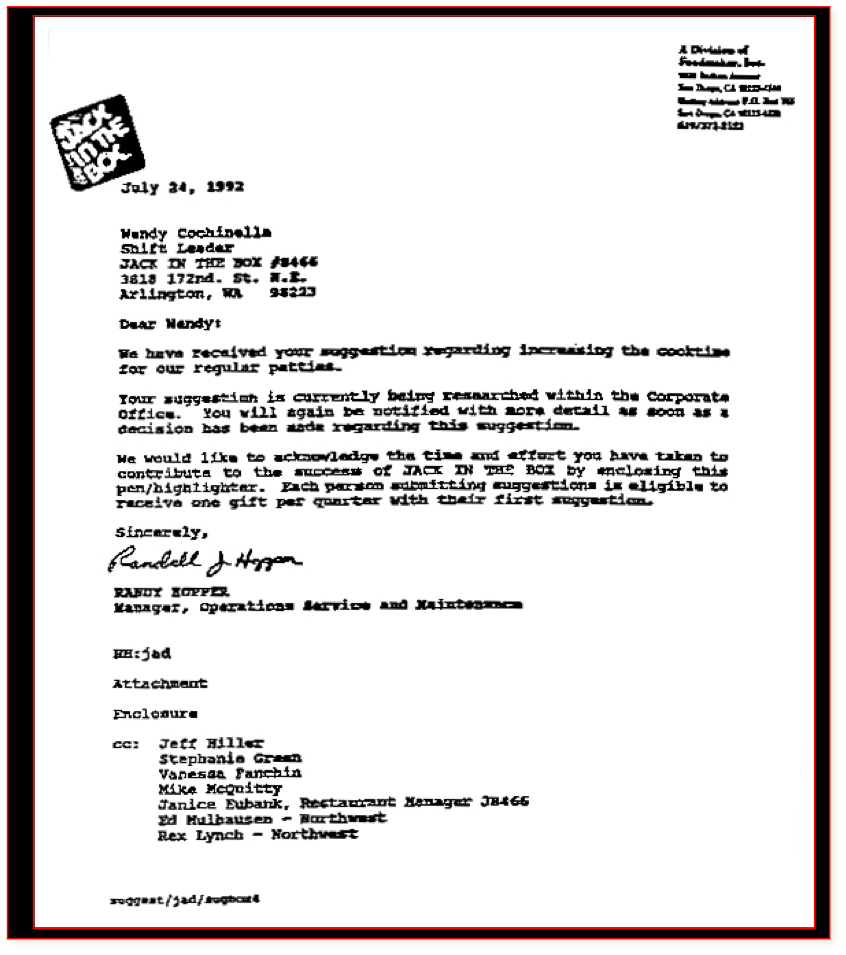
After just over a month, Wendy (and most of the Jack in the Box food safety team) received the below response from corporate headquarters. Wendy also received a pen highlighter (I always thought they should have made her at least Vice-President):
 
It reads:
We have received your suggestion regarding increasing the cook time for our regular patties.
Your suggestion is currently being researched within the corporate offices. You will again be notified with more detail as soon as a decision has been made regarding this suggestion.
We would like to acknowledge the time and effort you have taken to contribute to the success of JACK IN THE BOX by enclosing this pen/highlighter. Each person submitting suggestions is eligible to receive one gift per quarter with their first suggestion.
 
But it did not end there. No, Jack in the Box wanted to see if they could make “[their] burgers done and edible.” What they found in their corporate kitchen was that sometimes they could reach internal temperatures of 155 degrees and above on new grills with the two-minute cook time, but often—too often—internal temperatures of 140 degrees or below were reached on older grills with the two-minute cook time. E. coli O157:H7 bacteria can survive at 140 degrees for two minutes, but not at 155.
So, what was the response?
Yes, you guessed it, the two-minute cook time was more important than having “burgers done and edible.” Wendy’s next communication from corporate headquarters indicated that a cook time longer than two minutes made burgers “tough.”
 
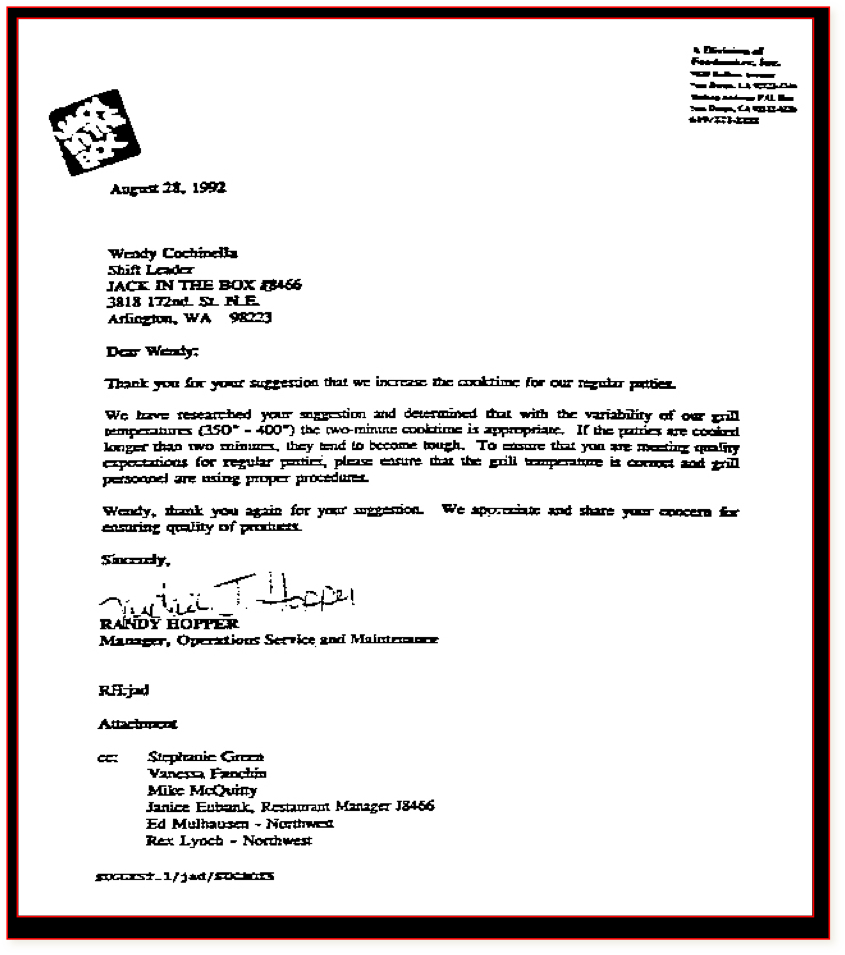
Wendy and the Jack in the Box food safety team received the following communication from superiors:
We have researched your suggestion and determined that with the variability of our grill temperatures (350° – 400°) the two-minute cook time is appropriate. If the patties are cooked longer than two minutes, they tend to become tough. To ensure that you are meeting quality expectations for regular patties, please ensure that the grill temperature is correct and grill personnel are using proper procedures.”
 
And, as they say, the rest is history—a tragic history.  Weeks after the outbreak was announced Jack in the Box changed the cook time from two minutes to two minutes and fifteen seconds – yes, fifteen seconds.

Food Innovation Asia Conference 2014 (12-13 June 2014) in Bangkok, Thailand

Intro:
The conference will provide opportunity to share experiences and strengthen networking among international food scientists and scientists in related fields from academia, government and food industries. The purpose is to highlight significant developments in research and innovations in food science and technology with an emphasis on innovation. There will be presentations and discussions in plenary, concurrent and poster sessions, informal gatherings, competitions and exhibitions.
 
Key highlights:
  • Food Health and Nutrition
  • Food Processing & Engineering
  • Food Microbiology, Food Safety and Quality
  • Food Chemistry and Analysis
  • Food Product Development and Ingredient Innovations
  • Sensory and Consumer Research
  • Food and Agricultural Packaging Technology and Innovations
  • Food Supply Chain Management
  • Food Security and Sustainability
  • Food Related Topics

  • More info? Kindly refer to the link below:
    http://www.fostat.org/index.php/event/food-innovation-asia-conference-2014-main

    IFT 14 Annual Meeting & Expo (21-24 June 2014) in New Orleans, USA

     
    For more info, kindly refer to the link below:
     

    Are secret, dangerous ingredients in your food? by Kimberly Kindy

     
    Food manufacturers are routinely exploiting a “legal loophole” that allows them to use new chemicals in their products, based on their own safety studies, without ever notifying the Food and Drug Administration, according to a new report by an environmental and consumer advocacy group.
    Natural Resources Defense Council identified 56 companies that were marketing products using 275 chemicals that the company’s hired experts decided met federal safety standards, known as Generally Recognized as Safe (GRAS). However, the science behind those safety findings and the use of the chemicals was disclosed to the FDA in only six instances. The New York-based NRDC called its report “Generally Recognized as Secret” and said the lack of transparency with the GRAS process is a public health threat.
     
    “If you don’t know when (an additive) is being used, how can you determine if it’s safe?” said Thomas Neltner, a chemical engineer and co-author of the study that was presented Monday at a Grocery Manufacturers Association’s Science Forum at Washington.
    In a prepared statement, the GMA defended the GRAS process, saying, “It is a very thorough and comprehensive process that has, under the current law provided FDA with authority to challenge the improper marketing of an ingredient as GRAS, and if necessary, act to remove products containing that ingredient from the food supply.”
     
    The FDA said that although the law allows for food manufacturers to make their own safety determinations, the agency “encourages companies to consult with the agency when developing new ingredients.” Ultimately, the FDA said, manufacturers “are responsible for ensuring that their food products are safe and lawful.”
     
    NRDC said that Food Additives Amendment of 1958 was enacted, the GRAS process was meant to apply to innocuous additives like vinegar. Instead, it is commonly used for chemicals that are potentially dangerous and have never before been in the American food supply. For example, until recently, artificial transfats were considered GRAS but the FDA has now deemed them dangerous, saying they cause as many as 7,000 deaths from heart disease each year.The organization said its findings are “likely the tip of the iceberg,” since the scientific work and GRAS determinations are not publicly disclosed and therefore difficult to track down.
     
     
    The organization spent more than a year reviewing trade journals and talking to food additive consultants to identify the 56 companies that frequently make their own safety determinations.
    The FDA’s food additive process allows companies to take several paths to determine the safety of new chemicals or other ingredients.
     
    The most transparent and rigorous path involves companies submitting a food additive petition – along with the science behind why they think the ingredient is safe — to the FDA in an effort to gain formal approval from the agency. Companies use the FDA approvals to promote the safety of their products.
     
    The other, non-public path that NRDC examined allows companies to determine GRAS status on their own without notifying the FDA.
     
    A third path allows companies to voluntarily submit their own GRAS determinations for FDA review and sign off, but they may withdraw the petition if the agency is worried about the safety of the additive. The agency announces the withdrawal but does not disclose whether it had safety concerns. The company may then go ahead and use its own GRAS determination to use the additive in products anyway. The NRDC found that one in every five GRAS petitions were either rejected by the FDA or the company voluntarily withdrew their petition.
     
    NRDC’s report also calls on the FDA to petition Congress for a new law that would require manufacturers to submit their safety determinations to the agency for review and approval. The council said it is encouraging consumers to “demand” that their grocery stores and their favorite brands sell only food products with ingredients that the FDA has found to be safe.
     
    At the event, the Grocery Manufacturers Association also announced a new food additive research center it has helped create at Michigan State University, which will be called the Center for Research on Ingredient Safety (CRIS). GMA’s chief science officer, Leon Bruner, said the center will operate independent of the association and will review the safety of ingredients, train future food toxicologists and serve as an “independent and credible source” for the public, news organizations and the industry.

    INNOVA FOOD 2014 CONFERENCE (27-29 August 2014) in Penang, Malaysia


    Food Technology Division of the School of Industrial Technology, Universiti Sains Malaysia, Penang is organizing an International Conference on Food Innovation ( INNOVAFOOD-2014 ) on 27 - 29 August 2014 at PARKROYAL Penang Resort, Malaysia.
     
     
    For more info, kindly refer to the link below:


    Friday, May 24, 2013

    10 Biggest Food Safety Scandals Ever !! By MATT GODDARD


    It’s a scary thought, putting your health and wellbeing in the hands of complete strangers halfway around the world. And the number of high profile, and often deadly, food scandals that have made headlines over the years definitely doesn’t ease troubled minds. There are various causes – from accidental contaminations to pure recklessness and even greed – but public outrage is universal.
    When it comes to health and safety surrounding food products, consumers rightly insist on measures that ensure their safety. And whether it’s criminal trials and bans, or bankruptcy and company closures, the public demands retribution as well. After all, health issues are no laughing matter. Here’s a look at 10 of the biggest food safety scandals in recent history.

    10. Sudan I – UK/Worldwide (2005)

    10-Sudan-I–UK-Worldwide-2005
    In 2005, the largest food recall in UK history began after industrial dye Sudan I was discovered in a shipment of Crosse & Blackwell Worcester Sauce. The additive, along with variants III and IV, was popularly used to color food before it was discovered to be carcinogenic and in 2003 was banned in many EU countries, including the UK. So, in 2005, Premier Foods (who owned Crosse & Blackwell until they sold it in 2011) faced media and public scrutiny when tests proved the presence of the chemical, which is often used in waxes, petrol, oils, polishes, and solvents.
    The dye was also discovered in other items, from pizzas to Pot Noodles, and in the end more than 400 products were recalled. Furthermore, contaminated products were discovered in Italy and South Africa as well. While there have been no direct fatalities, and there was consensus that the risk was pretty small, the potential future effect of the banned carcinogen could be serious, and immediate action was required. The origin of the contamination was eventually traced back to an adulterated batch of chili powder in India.
    Highlighting the international repercussions and reputational damage of such incidents, the government of Sudan lodged a request for the name of the dye to be changed.

    9. Chi-Chi’s Hepatitis A Outbreak – USA (2003)

    9-Chi-Chi’s-Hepatitis-A-Outbreak–USA-2003
    Internationally operated Mexican restaurant Chi-Chi’s has had a checkered financial history since it was founded in Richfield, Minnesota in 1975. However, 2003 was the chain’s darkest year, when a Chi-Chi’s restaurant at Beaver Valley Mall, Pennsylvania (30 miles northwest of Pittsburgh) was implicated in what has been described as the largest food-borne outbreak of hepatitis A in US history.
    Hepatitis A is an acute viral infection of the liver with low mortality rates in the US, but in November 2003 the virus led to the deaths of at least four people and infected a further 660 in the Pittsburgh area. Green onions were eventually identified as the source of the outbreak.
    Chi-Chi’s was already facing bankruptcy at that point, and by the time the cases were settled in 2004, the number of Chi-Chi’s restaurants in the US had halved. Eventually, Chi-Chi’s closed in the US for good and now only operates in Belgium, Luxembourg, the UAE, Kuwait, and Indonesia.

    8. Jack in the Box E. Coli Incident – USA (1993)

    8-Jack-in-the-Box-E-Coli-Incident–USA-1993
    Whether the source is contaminated water or undercooked meat, deadly bacterium Escherichia coli O157:H7, commonly referred to as E. coli, has garnered a lot of negative mainstream attention in recent years – but this incident was right up there with the worst of them.
    With thousands of outlets across the US, you’d think a company as big as Jack in the Box would do everything in its power to safeguard its burger empire – and the wellbeing of its customers. However, in 1993 the franchise was implicated when an outbreak of E. coli led to the deaths of four children and infected up to 700 people across four states, hospitalizing at least 171 of them.
    The outbreak was traced back to undercooked patties contaminated with fecal matter in the Seattle area and other parts of the Pacific Northwest. As you’d imagine, the scandal affected business, almost leaving the company bankrupt.
    Adding to the controversy, court documents revealed a company memo from just four months before the outbreak that read, “If patties are cooked longer… they tend to become tough.” And according to numerous other documents, Jack in the Box had already been warned about undercooked burgers and contaminated beef 10 months prior to the incident.

    7. Methanol Poisoning – Estonia (2001), Czech Republic (2012)

    7-Methanol-Poisoning–Estonia-2001--Czech-Republic-2012
    In September 2012, the Czech Republic banned the sale of alcoholic beverages with over 20 percent alcohol content following a series of deaths and serious illnesses traced back to methanol-tainted booze. According to the World Health Organization, the Czech Republic is the world’s second largest consumer of hard liquor after Moldova, and the country has struggled to stamp out bootleg alcohol for years.
    It’s thought that 20 individuals died within around two weeks of the poisoning outbreak, and according to reports, other people were left blind and even brain-damaged as a result of the incident. Cases also came to light in Slovakia after people consumed Czech-bought alcohol. And the problem led to Poland banning the import of Czech spirits for 30 days.
    The Czech Republic is not alone when it comes to tainted alcohol incidents in Eastern Europe. A crisis involving methanol-contaminated alcohol also hit Estonia in 2001, leading to the deaths of 68 people. Over a decade later, Estonian doctors fear the country is still not prepared for another similar event.

    6. Jalisco Mexican Cheese Listeria Incident – USA (1985)

    6-Jalisco-Mexican-Cheese-Listeria-Incident–USA-1985
    With a mortality rate of 20 to 30 percent, listeriosis is a serious bacterial infection particularly dangerous to newborn babies, the elderly, and those with weak immune systems. An infamous April 1985 outbreak in Los Angeles, California was linked to a popular Mexican soft cheese. And it proved particularly tragic, as it is thought to have caused as many as 62 deaths, including stillbirths.
    A month of investigations carried out by health officials traced the cause back to two types of Mexican-style cheese manufactured by Jalisco Mexican Products Inc. Most of those infected during the incident were members of California’s large Hispanic population.
    Listeria has been found in cattle but can be eliminated from milk during pasteurization. The District Attorney’s office discovered that Jalisco’s records proved they could not possibly have been pasteurizing all of their supplies and accused them of knowingly processing untreated milk. In the aftermath, Jalisco shut down permanently, and neither the company nor its insurers were unable to cover the estimated $100 million in compensation claims.

    5. Diethylene Glycol Wine Poisoning – Austria (1985)

    5-Diethylene-Glyco- Wine-Poisoning–Austria-1985
    In 1985, in an attempt to cash in on the popularity of their sweeter, late-harvest wines, a small number of Austrian wineries colluded to adulterate their stock with toxic diethylene glycol – a key ingredient in certain antifreeze brands that also gives wines a sweeter, more full-bodied flavor. The scandal was exposed in Germany, where the wines were illegally blended with local wines, spreading the contamination.
    While there were no recorded fatalities as a result of the incident, the world was shocked and the consequences were swift. The scandal made headlines around the globe, and the contaminated wines were immediately pulled from shelves. In the end, a combination of heavy fines and prison sentences (in Germany and Austria) and the resulting negative publicity meant that Austrian wine export volumes would not return to pre-scandal levels until 2001, over 15 years after the event.
    Interestingly, in 1937, a similar incident resulted in the deaths of over 100 people in the US after individuals consumed a contaminated elixir. This led to the instatement of the Federal Food, Drug, and Cosmetic Act of 1938.

    4. Salmonella and the Peanut Corporation of America – USA (2008)

    4-Salmonella-and-the-Peanut-Corporation-of-America–USA-2008
    From 2008 to 2009, an outbreak of salmonella spelled the end for 33-year-old Virginia-based peanut processing company, the Peanut Corporation of America. The devastating outbreak led to one of the largest food recalls in US history. In all, it caused the deaths of nine individuals, and at least 691 people – many of them children – were affected across 46 states.
    A subsequent investigation of the company’s facilities in Georgia, Virginia and Texas by the Food and Drug Administration proved damning. In Georgia, it was discovered that the company knew its peanut butter products were contaminated with salmonella but shipped them regardless. And between 2007 and 2008, this happened at least a dozen times. Meanwhile, the Texas investigation revealed that the plant hadn’t been inspected and wasn’t even licensed to manufacture food in the state.
    But salmonella wasn’t the company’s only concern. It was also revealed that a previous shipment of peanuts sent to Canada was not allowed to re-enter the US after it was found to contain a “filthy, putrid or decomposed substance” and fragments of metal.
    The company’s actions were widely condemned, and it was eventually forced to shut down. Georgia Agriculture Commissioner Tommy Irvin summed up the situation at the time: “They tried to hide it so they could sell it. Now they’ve caused a mammoth problem that could destroy their company – and it could destroy the peanut industry.”

    3. Karnataka Liquor Deaths – India (1981 and 2008)

    3-Karnataka-Liquor-Deaths–India-1981-and-2008
    Illegal alcohol has been killing people around the world for decades, but over the years, specific incidents have focused the world’s attention on the inherent health risks of bootleg liquor. In 1981, the Indian state of Karnataka was rocked by a wave of tainted booze-related deaths. In July that year, it’s thought that at least 308 people died after consuming cheap, methyl-contaminated alcohol.
    Yet even following such a tragedy, the problem remains serious in the region – and in 2008, alcohol laced with chemicals claimed the lives of 180 people in Karnataka. While authorities were quick to arrest some 20 dealers, and 25 customs officials were also suspended, the origin of the deadly product proved difficult to determine. What’s more, this recent case became even more complicated when police began investigating the possibility that political parties had supplied the alcohol in the run-up to state elections.

    2 E. Coli Outbreak – Germany (2011)

    2-E-Coli-Outbreak–Germany-2011
    In May 2011, people were advised to avoid eating bean sprouts, cucumbers, tomatoes and salads in Germany after Europe was hit by a serious outbreak of food-borne E. coli poisoning. Within weeks of the outbreak, German authorities were investigating the deaths of 17 people and the illnesses of a further 1,600.
    By this point, other countries around the world were also swept up in the pandemonium, and a ban was placed on EU vegetables. Eventually, the death toll numbered 53, with 51 of those fatalities in Germany. And the total number of affected people reached a staggering 3,950.
    Amid widespread panic, the World Health Organization described the outbreak as a “new and aggressive strain that could cause internal bleeding, kidney failure, and neurological symptoms.”
    Initially, it was suggested that the outbreak was caused by tainted Spanish cucumbers, which angered Spanish people and caused the country’s exporters to lose millions of dollars a week. In June 2011, German officials confirmed that the source of the outbreak was in fact bean sprouts from an organic farm in northern Germany.

    1. Melamine Milk Scandal – China (2008)

    1-Melamine-Milk-Scandal–China-2008
    One of the largest and most shocking food disasters of them all was the Chinese Milk Scandal that shook the world in 2008. Powdered baby milk and other dairy products across the country were found to contain dangerously high levels of the industrial chemical melamine – and the results were tragic. Staggeringly, some 300,000 people are estimated to have been affected.
    The melamine had a particular effect on victims’ kidneys. Tragically, six infants died from kidney stones and other kidney-related issues. Meanwhile, a further 860 infants were hospitalized.
    Confronted with what it believed was the largest food safety incident it had ever faced, the World Health Organization’s assessment was blunt. It described the incident as “clearly not an isolated accident, [but] a large-scale intentional activity to deceive consumers for simple, basic, short-term profits.”
    Several companies were found to have deliberately added melamine to their products, and a number of criminal prosecutions resulted in two executions, a suspended death sentence, and life incarcerations. The poisoning cast further bad light on the Chinese food industry, and after the scandal, 11 countries ceased importing Chinese dairy products.

    Maleic acid found in food products in Taiwan


    Taiwan's health authorities have uncovered the illegal use of maleic acid as a food additive in products from two factories, seizing an estimated 25 tonnes of product and ingredients before they could reach the market.
    The chemical was added to products including tapioca balls and rice noodles to give them more elasticity. A health official said maleic acid is not known to have adverse effects on human health, and has not been linked to cancer, adding that an average-sized adult could consume 30mg of maleic acid in a day without their health being affected.
    Health authorities were alerted in March and April that certain food manufacturers have been adding maleic acid to their products and launched an investigation into the tip-offs.
    After the seizure, concentrations of maleic acid of under 800ppm was found in the food, an amount deemed within a safe range. A doctor specializing in clinical toxicology at Chang Gung Memorial Hospital in New Taipei, said maleic acid is a poisonous industrial chemical and it is therefore unethical to add it to food, even in small amounts.
    The authorities will conduct a further investigation into the manufacturers involved and decide whether to issue a fine of NT$30,000 to NT$150,000 (US$1,000-$5,000).

    Source:
    Want China Times

    Friday, March 8, 2013

    Foodborne Illness Outbreaks Need More Aggressive Response by Dan Flynn


    From its headquarters on Baltimore harbor the 15-year old Center for Biosecurity of UPMC looks out on the historic Coast Guard Cutter Taney, the last ship afloat to have immediately fought back when Pearl Harbor was attacked in 1941.
    The  way the Taney instantly turned its guns on the enemy  is just the sort of reaction the U.S. needs to mount whenever and wherever there is an outbreak of foodborne illness, according to the Center’s new report “When good food goes bad.”
    “The sooner the source of an outbreak is identified, the sooner we can issue accurate targeted warnings and take the contaminated products off the shelves,” says Jennifer Nuzzo, who authored the report.   “And the sooner people stop eating contaminated food, the sooner the sickness stops.”

    Now an independent nonprofit organization of the University of Pittsburg Medical Center (UPMC), the Center for Biosecurity’s report calls for strengthening the U.S. response to foodborne disease outbreaks.  Only by stepping up its current ability to respond can the U.S. limit illnesses and deaths and economic costs, the new report says.
    “Foodborne illness sickens or kills an extraordinary number of people each year,” the report says. To illustrate how deadly foodborne illness outbreaks can be, the UPMC Center for Biosecurity pointed to the E. coli O104 outbreak in Germany that sickened 4,000 and killed at least 50 from eating sprouts and the U.S. Listeria outbreak that sickened and killed at least 33 from contaminated cantaloupe.
    “If public health officials can more quickly recognize when a foodborne illness outbreak has occurred and identify the food causing the outbreak, lives can be saved and economic losses averted,” says the report. “The lessons leanred from outbreak investigations cn be used by industry and government to address the underlying causes of contamination that lead to illnesses , thus making food safer for everyone.”
    The Biosecurity Center’s interest in food borne illness outbreaks apparently stems from the 2010 “credible threat” by Al-Qaeda terrorists to poison salad bars and buffets at hotels and restaurant over a single weekend, using ricin and cyanide.   “US officials cautioned that even in small amounts of these chemicals in food could cause serious harm,” says the report.
    That plot was not executed, but illustrated the problem.  “Initially, it will be very difficult to distinguish deliberate contamination of the food supply from a naturally occurring outbreak,” it says.
    It pointed to the 1984 incident in The Dalles, Oregon where a religious group out to influence a local election intentionally went around town poisoning salad bars with Salmonella, sickening many.  Before a criminal investigation found it was deliberate, public health officials blamed the outbreak on poor hygiene.
    “The continued three of deliberate contamination of food supplies highlights the important of strong systems for rapid detection and response for food borne illness outbreaks,” the report continues.  “Since a deliberate contamination of the food supply is likely to resemble a natural outbreak at the start, initial responsibility for responding to deliberate contamination events will flu to state and local health departments.”
    The Center says the report is intended to “catalyze improvements in the country’s ability to respond to large foodborne disease outbreaks. “
    “We analyzed the existing data and studies on foodborne illness outbreak response, identified emerging trends, and interviewed dozens of federal and state level officials and experts from industry, professional organizations, academia, and relevant international organizations,’ it says.
    Among its findings:
    • Foodborne illness outbreaks continue to impose enormous health and economic burdens.
    • Effective surveillance for and rapid response to foodborne illness outbreaks are critical to overall preparedness.
    • National surveillance programs have led to meaningful improvements in detection of foodborne illness outbreaks and can drive improvement in food safety.
    • Determining the source of foodborne illness outbreaks remains the top response challenge and will likely become harder as the complexity of the food supply increases.
    • Heterogeneity in states’ capacities to detect and respond to outbreaks creates national vulnerabilities.
    • Increased adoption of culture-independent diagnostic testing by the clinical sector threatens to undermine early detection of foodborne illness outbreaks.
    • Tapping nontraditional data sources may help improve detection and response to outbreaks.
    • Better integration of existing surveillance programs is necessary to improve outbreak detection and response.
    • Federal funding cuts are expected to compromise the public health system’s ability to respond to foodborne illness outbreaks.
    • The Food Safety Modernization Act has the potential to significantly improve the safety of the U.S. food supply, but will likely do little to improve public health response to foodborne illness outbreaks.
    In its findings, the UPMC Biosecurity unit accepts estimates that foodborne illness outbreaks cost the U.S. more than $77 billion annually, including 128,000 hospitalizations and 3,000 deaths. It also recognizes the problem that so-called fast tests on patients are causing in spotting outbreaks because they do not require isolation and culturing of pathogens.
    The report comes with five recommendations. They are:
    1. The U.S. government should fund the development of next-generation technologies that provide rapid diagnosis while preserving the capacity to identify and resolve large outbreaks.
    2. Congress should restore funding for state health departments.
    3. The U.S. should develop a foodborne illness outbreak response network that taps expertise and data that exist in the private sector.
    4. Congress should adequately fund and agencies should fully implement the FSMA, including provisions for strengthening surveillance and response to outbreaks.
    5. The U.S. government should improve integration of existing foodborne illness surveillance efforts.
    The report says a new technological solution is needed to the problem created by greater use of the fast tests. It says small increases in state health department capacities can substantially increase the country’s ability to respond to foodborne illness outbreaks. State and local health agencies need more direct connections with the private sector.
    In addition, the report says more access to healthcare data would help expedite responses to outbreaks. It suggests using the “national framework” being built through electronic health records.
    The nonprofit University of Pittsburgh Medical Center (UPMC) is a $10 billion health enterprise including 20 hospitals, 4,200 licensed hospital beds, and 400 outpatient sites with 1.5 million members and 54,000 employees.
    The mission of the Center for Biosecurity of UPMC is to strengthen U.S. national security and resilience by reducing dangers posed by epidemics, bio threats, nuclear disasters, and other destabilizing events.  Among its research topics last year were “Preparing for Bioterrorism” and “Radiological Disasters: What’s the Difference?”
    The Center has been associated with UPMC since 2003.
    USCGC  Taney (WHEC-37) is a Treasury-class Coast Guard Cutter that was moored in nearby Honolulu Harbor when the Japanese attacked Pearl Harbor without warning on Dec. 7, 1941. Taney’s anti-aircraft guns were immediately put to use defending the airspace over the city. After 50 years of service, including World War II, Korea, and Vietnam, the Taney was decommissioned in 1986 and since then has been a museum ship on Baltimore harbor.

    EPA/USDA Food Safety Statements in PDP Report Helpful to Consumers by Marilyn Dolan


    In late February, the United States Department of Agriculturereleased its annual Pesticide Data Program report results. Once again, USDA strongly reiterated that “U.S. food does not pose a safety concern based upon pesticide residues.” The Environmental Protection Agency echoed that statement and added that “EPA remains committed to a rigorous, science-based and transparent regulatory program for pesticides.”
    But this year, under the Obama Administration, both the USDA and EPA did a stellar job further explaining to consumers about the food safety processes in the “Q and A” and “What Consumers Should Know” portions of the PDP report. Both sections clearly and concisely explained how the government and corresponding regulatory processes and systems are protective of all consumers, including infants and pregnant women. We applaud the inclusion of this food safety information within the context of the report since it will be so very reassuring to consumers.
    While the issue of pesticide residues often gets attention from both social and traditional media outlets, the release of this report and the important accompanying statements by USDA/EPA receive very little coverage each year. The adage that “good news rarely gets attention” may apply here. Ironically, there are groups that manipulate and twist the USDA PDP results to generate their own “reports” in a manner that unfairly disparages the safety of conventionally grown, affordable produce. This misleading information raises fear and concerns among consumers and, unfortunately, does generate media coverage since it communicates perceived “bad news.”
    But, raising fear without facts is a disservice to families trying to put healthy food on the table. And this manipulation of government data at the expense of consumer confidence is a detriment to public health, especially when American’s need to include more fruits and veggies in their daily diets.
    Families deserve factual, science based and balanced information. The Obama Administration provided that on Friday through the information presented in the Pesticide Data Report. Hopefully, when faced with future manipulations of the PDP report, consumers and others will go back, review the content of the report and remember what was actually said – it was, in fact, very good news.

    Thursday, March 7, 2013

    Two Dozen Now Sickened in AK Raw Milk Campylobacter Outbreak


    The number of people sickened with Campylobacter infections linked to raw milk in Alaska has now risen from 18 to 24, reported health officials this week, according to news channel KTVA 11.
    Two patients have been hospitalized as a result of their infections, according to the Alaska Section of Epidemiology (SOE).  One of the victims is an infant who contracted a secondary infection, and did not drink the raw milk directly.
    The bacteria has been traced to a cow share program on the Kenai Peninsula.
    The milk was distributed to shareholders throughout the Kenai Peninsula, in Anchorage, and in Sitka, according to a February 22 press release from the SOE.
    The last Campylobacter outbreak traced to raw milk in Alaska was in 2011. A total of 18 people were sickened from that milk, also produced by a cow share program.
    Source: Food Safety Net

    Wednesday, March 6, 2013

    Industry Test Results on Beef Products Published – Update from FSA (UK)


    UNITED KINGDOM – The Food Standards Agency (FSA) has received the third set of test results from the food industry, which has been checking for the presence of horse DNA in products that are labelled as beef.
    Overall, including the previous weeks’ testing, the Agency has received 5430 test results. The updated information from the food industry’s own tests is as follows:
    • As in previous weeks, the vast majority (over 99%) of tests continue to show no horse DNA at or above the level of 1%.
    • Results show that four further products have been confirmed as containing horse DNA, since the previous set of industry results was announced last week. These four products are covered by 10 test results that show horse DNA at or above the 1% threshold. These products are named in the attached report (see Table 1) and have been withdrawn from sale.
    • There are now 17 products confirmed as containing over 1% of horse DNA, which have been identified through the industry tests (Table 1). A further two products have been identified through separate tests (Table 2).
    • To date, no tests of products containing horse DNA have found the veterinary medicine phenylbutazone (bute).
    The FSA focus continues to be on gross contamination of beef products with horse meat, that is, where there is more than 1% horse DNA detected in a product. The Agency believes that such levels of horse DNA indicate either gross negligence or deliberate substitution of one meat for another.
    Results have now been received from a range of manufacturers, retailers, caterers, restaurants and wholesalers throughout the UK. The initial phase of testing by industry is almost complete.
    There have been, and continue to be, occasions where businesses have withdrawn products due to trace contamination levels, or on a precautionary basis; for example, where they have been produced by manufacturers that have supplied other products found to be contaminated with horse DNA.

    Table 1
    Third report on results of industry testing of meat products
    1 March 2013: products linked to positive results for horse
    CompanyLinked products 
    ALDIToday’s special frozen beef lasagne
    Today’s special frozen spaghetti bolognese
     
    ASDAChilled Beef Bolognese Sauce 
    Bird’s Eye*Traditional Spaghetti Bolognese
    Beef lasagne
     
    Brakes*Brakes spicy minced beef
    skewer
     
    Co-operativeFrozen: 4 Beef Quarter Pounder Burgers 
    FindusFindus beef lasagne (320g, 360g, 500g) 
    RangelandBurger products 
    SodexoHalal beef burgers, minced beef, halal minced beef 
    Taco Bell*Ground beef 
    TescoEveryday Value frozen burgers
    Everyday Value Spaghetti Bolognese
     
    Whitbread Group plcLasagne, beef burger 
    *Results added since the second report on 22 February 2013. All products have been subject to product withdrawal and appropriate notification to customers and consumers.

    Table 2
    Other products that contain horse DNA above 1%
    CompanyLinked products 
    MakroFrozen MQ 100% Aberdeen Angus Beef Burgers 12 6oz 
    The Burger Manufacturing Company (BMC)A range of beef products