Saturday, August 28, 2010

Information Security Management System (ISO/IEC 27001)- 2W Questions


What is ISO/IEC 27001 (ISMS)?

 is auditable international standard which defines the requirements for an
Information Security Management System (ISMS) was established in 2005
 replaces the BS7799 requirements with the intention to provide the
foundation for third party audit, and is 'harmonized' with other management
standards, such as ISO 9001 and ISO 14001
 helps establish and maintain an effective information management system
 applies to all types of organizations
 is designed to be used for certification purposes
 lists a set of control objectives and controls
 emphasize on a continual improvement approach


Why ISO 27001 (ISMS)?


 a comprehensive approach to the management of information security in the
organization
 ensuring business continuity especially in the event of emergency
 ensuring compliance with the law and regulations
 reducing financial damage due to information theft and fraud
 assist in uphold of reputation of the organization as well as it’s brand
 provision of timely detection, reporting and management of security
incidents. Thus, minimize the impacts of security events
 better planning and investing in areas where proper management and
elimination of security threats are necessary
 competitive advantage and provide confidence to certified organizations as
the certification proves proper protection and management of information

Wednesday, April 21, 2010

ICR Malaysia - Green office initiatives in Malaysia: Getting the basics right

Green office initiatives in Malaysia: Getting the basics right

Reproduced with permission from CSR Asia by Gabriel Chong

Here are some key lessons learned and shared by Malaysian companies who are ahead in the green office agenda:

•Changing values: Core to the success of many of these programmes was changing values of individuals to understand their impacts as an individual. Don’t just implement a programme; work with staff to understand why you’re doing it. You stand a much better chance success.
•Do away with rubbish bins: As a society we are addicted to just throwing things away! A company removed personal rubbish bins and replaced them with recycle bin in different departments. Now, to throw anything away, you actually had to get up and think about it before you throw it.
•Measure: Don’t just say you are doing; show you do by measuring and reporting how much your impacts are. Water, electricity, paper, fuel consumptions are areas that office based operations can easily monitor and improve efficiencies or reduce consumption.
•Carbon emissions: A review sustainability reports of Malaysian companies would suggest that companies are aware of their CO2 emissions judging by the number of tree planting activities that companies do as a way of offsetting their CO2 emissions. However, upon scrutiny, these companies plant trees with no knowledge of the emissions that their company emits in the first place! Without baseline knowledge, how do companies know they are actually offsetting their emissions and have they reviewed operational areas where emissions can be reduced in the first place? Start with measuring your emissions.
•Incentives, not subsidies: Working in a city that is addicted to cars, I’ve never heard of a successful car pooling scheme till a company shared their approach. As covered parking was limited, only those who car pooled are allowed to park under cover, and sometimes get their car washed!
•Address different departments: One size does not fit all in developing green office initiatives. The impacts of drivers in an office car pool and secretarial services for example are different, so they have to be looked at and addressed differently.
•Encourage working from home: With our technological infrastructure, this is possible and should be encouraged. Even the Malaysian government is getting into this through the introduction of a three-month trial Home Working Programme starting Jan 1, involving 35 draughtsmen in the Public Works Department.
•Push it further: Companies present at the workshop worked with their vendors to ban Styrofoam containers and plastics from their workplace canteens and corporate functions. Another looked at how their recycled materials were collected to ensure that it wasn’t being tipped elsewhere!

Link to:

ICR Malaysia - Green office initiatives in Malaysia: Getting the basics right

Monday, February 8, 2010

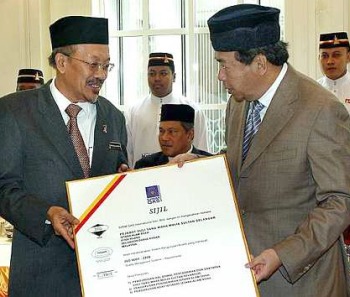
Selangor’s palace first to receive ISO cert


Published: The Star - Monday February 8, 2010 MYT 4:38:00 PM

Selangor’s palace first to receive ISO cert
KLANG: Selangor’s Istana Alam Shah became the first palace office in the country to receive the MS ISO 9001:2008 certificate for quality management system from Sirim QAS International.

Istana Alam Shah was judged on three aspects -- the management of the sultan’s gourmets, the administration of the palace, and the management of the palace’s customs and traditions.

The audit was carried out by two Sirim QAS officials on Dec 23 and 24 last year.

The Sultan of Selangor Sultan Sharafuddin Idris Shah received the certificate from Sirim Berhad president and chief executive officer Yahaya Ahmad at Istana Alam Shah here Monday.

Datuk Pengelola Bijaya Diraja Selangor Datuk Zakaria Abdul Rahman said the award dispelled an assumption that the palace was merely carrying out duties on the instruction of the sultan without adhering to a set of procedures.

Earlier, Yahaya said so far 4,793 companies and organisations in Malaysia were ISO 9001 certified for quality management systems. -- Bernama


Link:
Selangor’s palace first to receive ISO cert

Saturday, January 9, 2010

CIMB Islamic Bank clinches Best Overall Islamic Bank award

Written by Lam Jian Wyn
Friday, 08 January 2010 16:42
www.theedgemalaysia.com

KUALA LUMPUR: CIMB Islamic Bank Bhd has clinched the “Best Overall Islamic Bank” award by the 5th Annual Islamic Finance News (IFN) Awards Poll 2009.

The bank said on Friday, Jan 8 that it had also clinched several awards in the same poll, which were the "Most Innovative Islamic Bank" and "Best Islamic Bank in Malaysia".

The bank also recorded a first when it was named the "Best Islamic Wealth Management Provider", whereas CIMB-Principal Islamic Asset Management was voted the "Best Islamic Fund Manager".

The group head of Islamic banking division of CIMB Group and chief executive officer of CIMB Islamic Badlisyah Abdul Ghani said: "Despite the tough economic environment, the year 2009 has been a rewarding for us, as we saw strong growth of our Islamic finance business across all market segments regionally."

In the IFN Awards Poll, readers choose the best Islamic financial services providers across a series of markets and sectors. IFN readers comprise of Islamic finance issuers, investors, non-banking financial intermediaries and government bodies from around the world.


Link:
CIMB Islamic Bank clinches Best Overall Islamic Bank award

Tuesday, January 5, 2010

Towers Perrin and Watson Wyatt complete merger, now Towers Watson

Written by Ellina Badri
Monday, 04 January 2010 23:08

KUALA LUMPUR: Towers Watson & Co has completed the merger of Towers Perrin and Watson Wyatt to form Towers Watson, a global professional services company listed on the New York Stock Exchange and the Nasdaq.

In a statement today, Towers Watson said Watson Wyatt chief executive officer John Haley would serve as Towers Perrin chairman and CEO, while Towers Perrin CEO Mark Mactas would become deputy chairman, president and chief operating officer.

The deal had been valued at US$4 billion (RM13.68 billion).

"We are delighted to finalise the merger and look forward to bringing a broader portfolio of services to our clients," Haley said.

"When it comes to managing costs, risks and people, the world is growing more complex everyday. Towers Watson is uniquely positioned to help our clients gain the perspective necessary to take the right actions to drive business results," he added.

Meanwhile, Mactas said with the combined experience, breadth and depth of skills, Towers Watson would be able to provide greater insight as it worked with its clients and greater opportunities for its people and shareholders.

As a result of the merger, Towers Watson was expected to issue 46.9 million shares of Class A common stock and 29.5 million shares of Class B common stock, which would be subject to transfer restrictions and would generally convert into freely-tradable shares of Class A common stock on a one-for-one basis over the next four years.

Towers Watson would also pay US$200 million in cash and issue one-year promissory notes in an aggregated principal amount of US$200 million to certain former Towers Perrin shareholders who had voluntarily elected to terminate their employment with the company.

Link:
Towers Perrin and Watson Wyatt complete merger, now Towers Watson